Compare
Superboard vs. Airtable: data platform or mission home?
Airtable is a mature platform for building applications and workflows on shared relational data. Superboard is a focused mission home where one Owner keeps the work, artifacts, judgment, Ava, and history together.
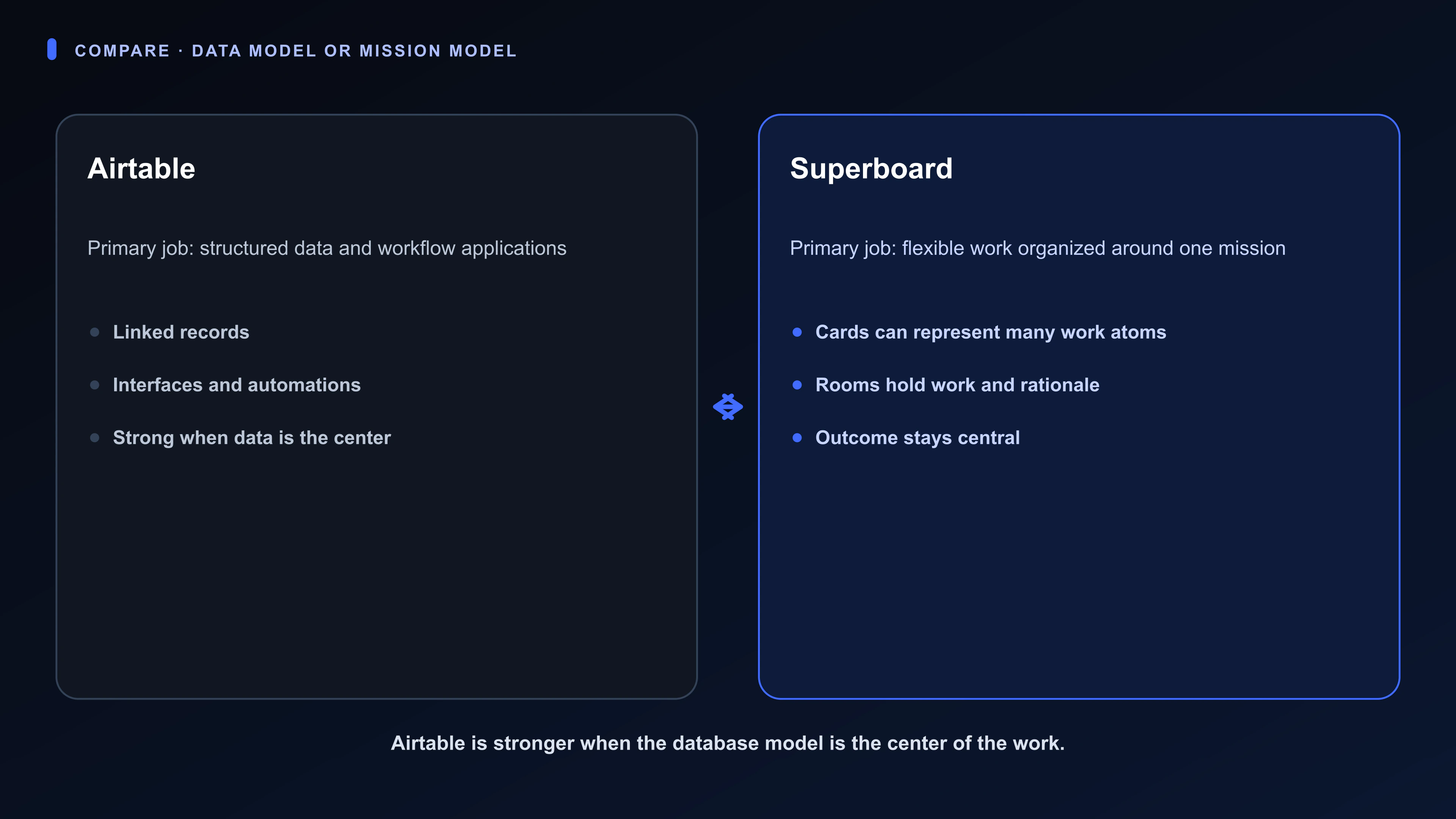
Airtable is the stronger choice when relational data and custom business applications are the main job.
The Owner keeps the mission, constraints, consequential decisions, and external authority; Superboard keeps the work and history around that judgment together.
Real-time small-team collaboration is Next. Direct integration, production multi-agent work, broader external execution, and cross-Board decision ranking are Direction.
The shortest useful comparison
| Dimension | Airtable | Superboard |
|---|---|---|
| Primary organizing unit | Bases, tables, records, fields, interfaces, and applications | A Board for the mission; Cards open into Rooms |
| Central job | Airtable is strong when structured shared data, configurable applications, interfaces, integrations, automations, governance, and organizational scale are central. | Keep the operating picture, artifacts, decisions, Ava, and history together |
| AI role | Airtable embeds AI and agents into data-backed applications and automations | Ava works inside the mission structure; broader external execution is Direction |
| Current collaboration | Mature collaboration varies by product surface and plan | Solo-first; small-team realtime collaboration is Next |
| Recovery | History and recovery depend on the product surface | Activity, supported Undo, Removed Items, and bounded recovery copies |
Airtable or Superboard, in one sentence
Choose Airtable when relational data and custom business applications are the main job. Choose Superboard when one Owner needs the mission, flexible work, artifacts, decisions, Ava, and history to remain connected around an outcome.
Keep the roadmap labels exact: real-time small-team collaboration is Next. Direct integration, production multi-agent coordination, broader external execution, cross-Board decision ranking, and broader point-in-time rollback are Direction, not available today.
What Airtable does especially well
Airtable is strong when structured shared data, configurable applications, interfaces, integrations, automations, governance, and organizational scale are central.
- Relational data and custom business applications are the main job.
- Teams need mature interfaces, automations, permissions, and integration options.
- A configurable schema is more valuable than a focused mission structure.
What Superboard organizes differently
Airtable begins from structured records, fields, relationships, interfaces, and automations. Superboard begins from one outcome and lets Cards remain flexible: a decision, customer, appointment, prompt, artifact, or task can each open into a Room without first becoming a relational schema.
Current Superboard is much narrower in data modeling, automation, permissions, and organizational scale. It is one signed-in Owner and a bounded Ava foundation, not an application platform or database replacement.
What remains with the Owner
The Owner retains the mission, its constraints, consequential decisions, and authority for actions outside Superboard’s current supported boundary. Ava can organize and prepare supported work, but a model’s capability never decides the outcome or creates permission for an external commitment.
When to choose Airtable
- Relational data and custom business applications are the main job.
- Teams need mature interfaces, automations, permissions, and integration options.
- A configurable schema is more valuable than a focused mission structure.
When to try Superboard
- The work is mission-shaped rather than database-shaped: its artifacts, decisions, conversation, current state, and history need one home.
- One Owner wants flexible Cards and Rooms without first designing a base, fields, interfaces, and automations.
- You accept that Airtable remains stronger for shared relational data, application building, and mature workflow automation.
How they can work together
Airtable can remain the structured data or workflow system while a Superboard Card holds the surrounding mission, decision, customer context, artifact, and history. There is no current direct Airtable integration documented in Superboard Help.
Available today
Current Superboard limits
Superboard is solo-first, early, and Board-first today. It does not match Airtable’s relational data model, interfaces, automations, permissions, integration options, or organizational scale. A direct integration exists only when current Help documents it.
Real-time small-team collaboration is Next. Direct integration, production multi-agent coordination, broader external execution, cross-Board decision ranking, and broader point-in-time rollback are Direction rather than current capabilities.
Direction
Next and Direction, plainly
Next means real-time small-team collaboration. Direction means direct integration, production multi-agent coordination, broader external execution, cross-Board decision ranking, and broader point-in-time rollback. None of those Direction capabilities is available today.
Official sources
Material claims about the other product were checked against these first-party sources on 2026-08-16.