Learn
How AI can learn your way of working without taking control
A useful Co-owner should stop making you repeat the same context. That requires durable learning, honest correction, and strict separation between what Ava remembers and what Ava is allowed to do.
Ava’s working knowledge should be private and internal, grounded in source truth and corrected through ordinary conversation.
The Memory Spine direction moves from source events to episode records, versioned understanding, and only the relevant context for the current turn.
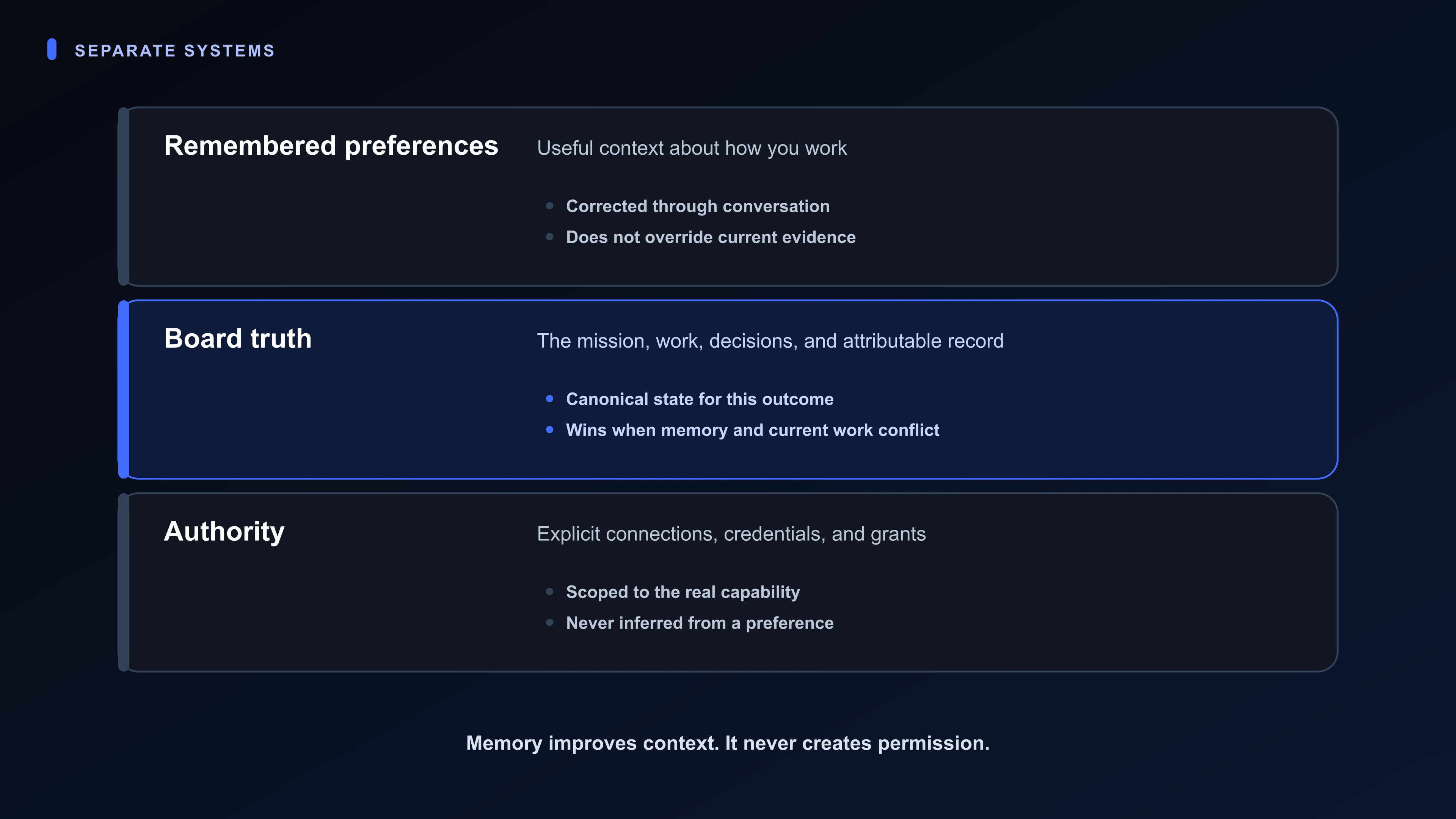
Remembering a preference can improve a recommendation. It can never grant permission to send, spend, publish, delete, disclose, or commit.
Learning should reduce repetition, not human control
A person should not have to restate the same goal, relationship, preference, or prior decision every time the work continues. Over time, Ava should understand what matters, which details deserve care, how the person communicates, and what earlier choices mean for the next step.
That working knowledge is meant to help Ava orient and recommend well. It does not replace the source material, decide what the person values, or silently expand what Ava may do.
Direction
Correction should sound like correction
When Ava gets something wrong, the natural response should be ordinary conversation: ‘Actually, this customer prefers a short note,’ ‘That appointment is for my father, not me,’ or ‘I always want to review pricing changes.’ The system should preserve the correction with its source and use it when relevant later.
The person should not have to edit a database of hidden facts to steer the relationship. Conversational correction, clear source truth, and real controls for forgetting or rebuilding derived memory are the Direction.
Direction
Direction: four plain layers of a private Memory Spine
An episode says what happened once. Versioned semantic understanding holds a durable pattern only while the evidence supports it. A projection brings the small relevant part into the current turn.
The original evidence remains more authoritative than a summary. New information can revise the understanding rather than forcing Ava to pretend an old inference is permanent truth. A current task receives only a bounded relevant projection—not an entire life history dumped into every prompt.
| Layer | Plain-language job | Example |
|---|---|---|
| Source truth | Keep the original message, decision, event, or artifact as evidence | Al corrects the approved minimum margin in the estimate Room's Chat |
| Episode record | Record what happened in one meaningful interaction | Al reduced Oak Street's scope after the customer asked for a lower price, while preserving the margin |
| Versioned semantic understanding | Maintain a bounded, revisable understanding of durable patterns | Al protects margin before offering scope or schedule flexibility |
| Relevant projection | Bring only the useful context into the current turn | The next estimate receives the current customer facts and Al's margin pattern—not his entire history |
Direction
Working knowledge is not a memory browser
Ava’s working knowledge is internal infrastructure for a coherent relationship. Superboard does not promise a page where a person browses every latent fact, manages raw embeddings, or approves each inferred sentence one by one.
That does not mean memory should be unaccountable. The direction includes conversational correction, source-grounded explanations when needed, and controls to suppress, forget, or rebuild derived memory. The product should expose useful control without turning the person into a database administrator.
Memory and authority are different systems
A remembered preference can help Ava prepare a better recommendation. It cannot create authorization. Knowing that someone usually chooses the fastest shipping option does not permit a purchase. Remembering a preferred writing style does not permit a message to be sent.
Actual capability, connector consent, resource scope, and consequence limits remain enforceable boundaries. The Co-owner or Collaborate posture does not change that separation.
Available today
Available today: Board context, not shared personal memory
Current Superboard works from the Board and Card Rooms in front of it. It can derive Board and Card reads, preserve conversation and artifacts, and search indexed Board content. It does not yet use a shared personalized Memory Spine.
Superboard’s sibling life product, You.one, already has a personalized semantic-memory path. Superboard is not connected to it: it does not consume that writer, retrieval runtime, or person-memory projection today. One shared Ava and memory foundation across the products is approved Direction, not current integration.