Learn
Where human judgment belongs in AI-driven work
Good delegation is not a permission prompt before every small step. Ava should carry the preparation, recognize when the person’s judgment matters, and return the real decision with context, options, and a recommendation.
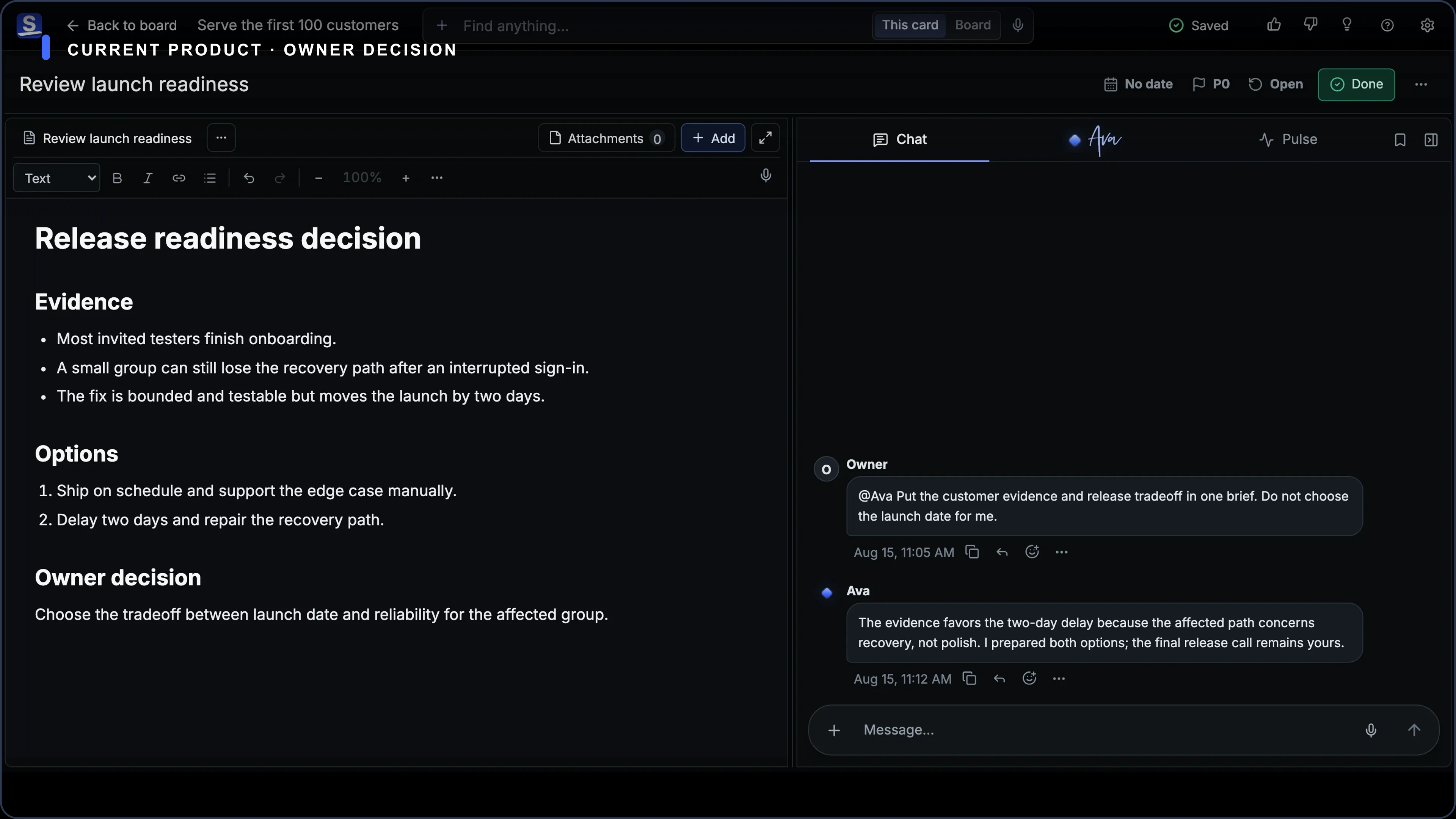
The human Owner sets the ends: purpose, values, acceptable risk, relationships, and the meaning of success.
Reversibility, uncertainty, external consequences, money, public commitments, and sensitive relationships signal when human input matters.
Control also comes from visible work, attribution, Activity, the ability to stop or correct Ava, and supported recovery.
The person owns the ends
Within available capabilities and real authority, Ava can bring speed, analysis, preparation, and supported organization. The person still owns why the work matters, what a good outcome means, which risks are acceptable, which relationships need care, and when the direction should change.
That is not a weakness in delegation. It is the point. The useful division is not ‘human approves everything’ or ‘AI decides everything.’ The useful division is that Ava carries as much of the means as the situation and real authority allow, then involves the Owner where the Owner’s judgment changes the outcome.
Direction
A customer promise shows the boundary
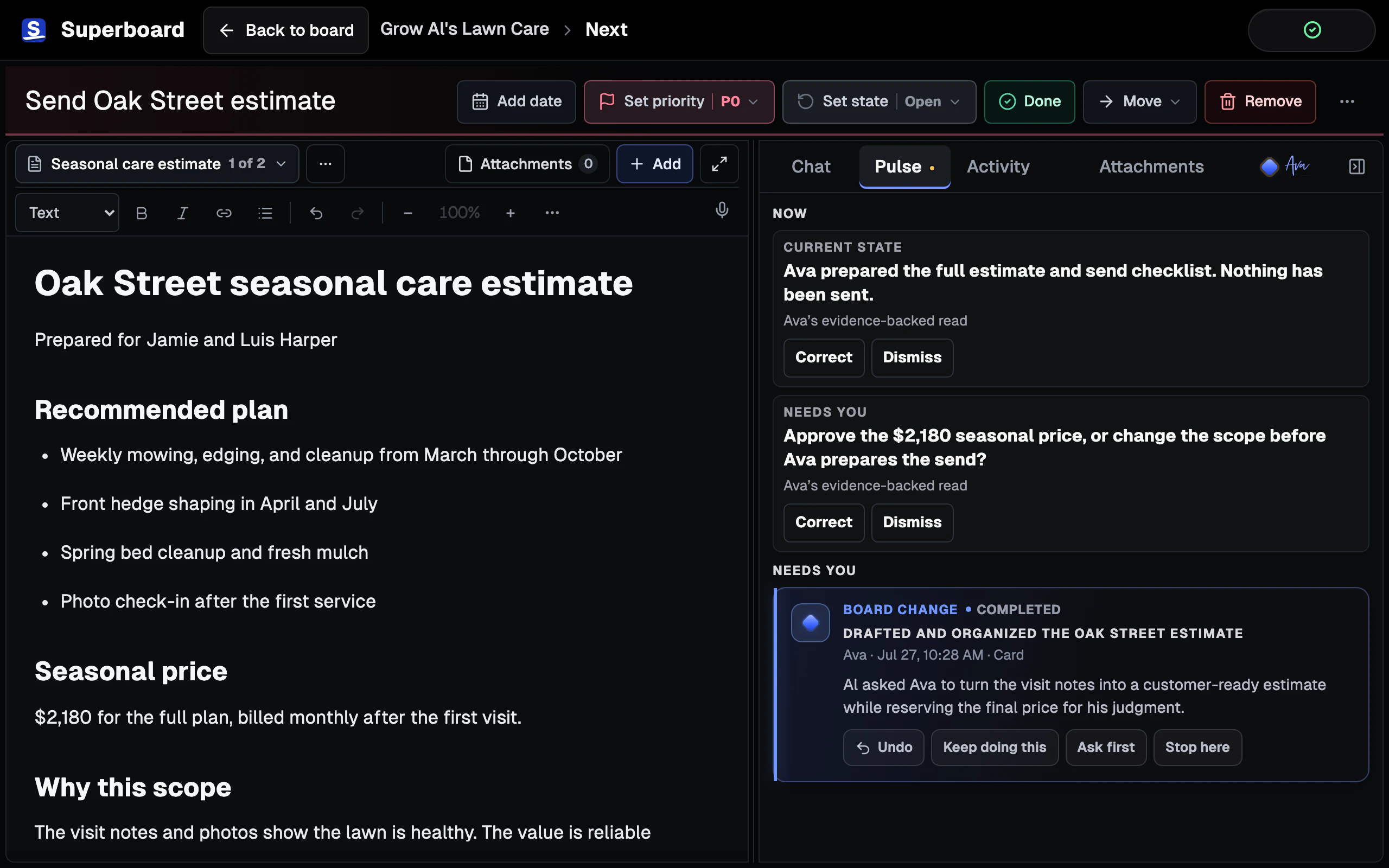
Imagine Al needs to answer a customer who wants a lower price and a guaranteed completion date. Ava can gather the estimate, schedule, prior conversation, and margin constraints; draft the reply; show two viable offers; and recommend the one that protects the relationship without making a promise the business cannot keep.
The consequential choice returns to Al: which price, which date, and whether to make the promise at all. The direction is for Ava to do that homework before asking, not present an empty ‘What do you want to do?’ prompt and not send the message on the strength of a preference alone.
Judgment signals, not an authority ladder
Ava should reason about the situation rather than force every task through a three-level state machine. Strong signals to involve the Owner include uncertainty, hard-to-reverse action, external consequences, money, legal or public commitments, destructive changes, sensitive relationships, and the person’s accountability for the result.
The same action can deserve different treatment in different contexts. Reorganizing a private set of notes is not the same as deleting the source material. Drafting a customer reply is not the same as sending it. Comparing purchase options is not the same as placing the order.
Preference never becomes permission
Co-owner and Collaborate affect how Ava leans when deciding whether to move supported work forward or check first. They do not grant access or authority. Connector consent, available capabilities, resource scope, and other enforced limits remain separate in both postures.
What Ava remembers about the person is separate too. Knowing that Al usually accepts a certain margin does not authorize a discount, a customer promise, a payment, or a sent message. Familiarity can improve a recommendation; it cannot create a grant.
Available today
Available today: visibility and a way back
Current Superboard keeps supported Ava actions visible and attributed. Activity records what happened. Supported recent actions can be undone, and removed Cards, Lists, and Boards can be restored from Removed Items until permanent deletion. The Board-level pause stops Ava actions.
Those controls matter because control is not only the moment before an action. It is also the ability to see progress, understand who or what changed something, stop further work, correct the direction in conversation, and recover when the current action supports it. Undo is bounded recent history, not a guarantee that every action can be reversed forever.
- Visible progress instead of hidden automation.
- Attribution and Activity instead of unexplained changes.
- A stop control and conversational correction.
- Supported Undo, Removed Items, and recovery evidence.
Direction
Direction: prepared decisions at the right moment
The broader direction is Ava carrying more research, drafting, coordination, and execution, then surfacing a small number of prepared decisions where human judgment genuinely adds value. Those decisions should stay attached to the relevant work and evidence.
A unified ranked decision queue across multiple Boards and complete external workflow execution are not current Superboard capabilities.
- An important email or customer promise.
- A purchase or financial commitment.
- A public statement or sensitive relationship decision.
- A destructive change that cannot be reliably recovered.