Learn
Why serious work needs Undo, restore, and recovery
Moving faster is only useful if a mistake does not become a disaster. Superboard treats recovery as part of the operating model, not a support-only afterthought.
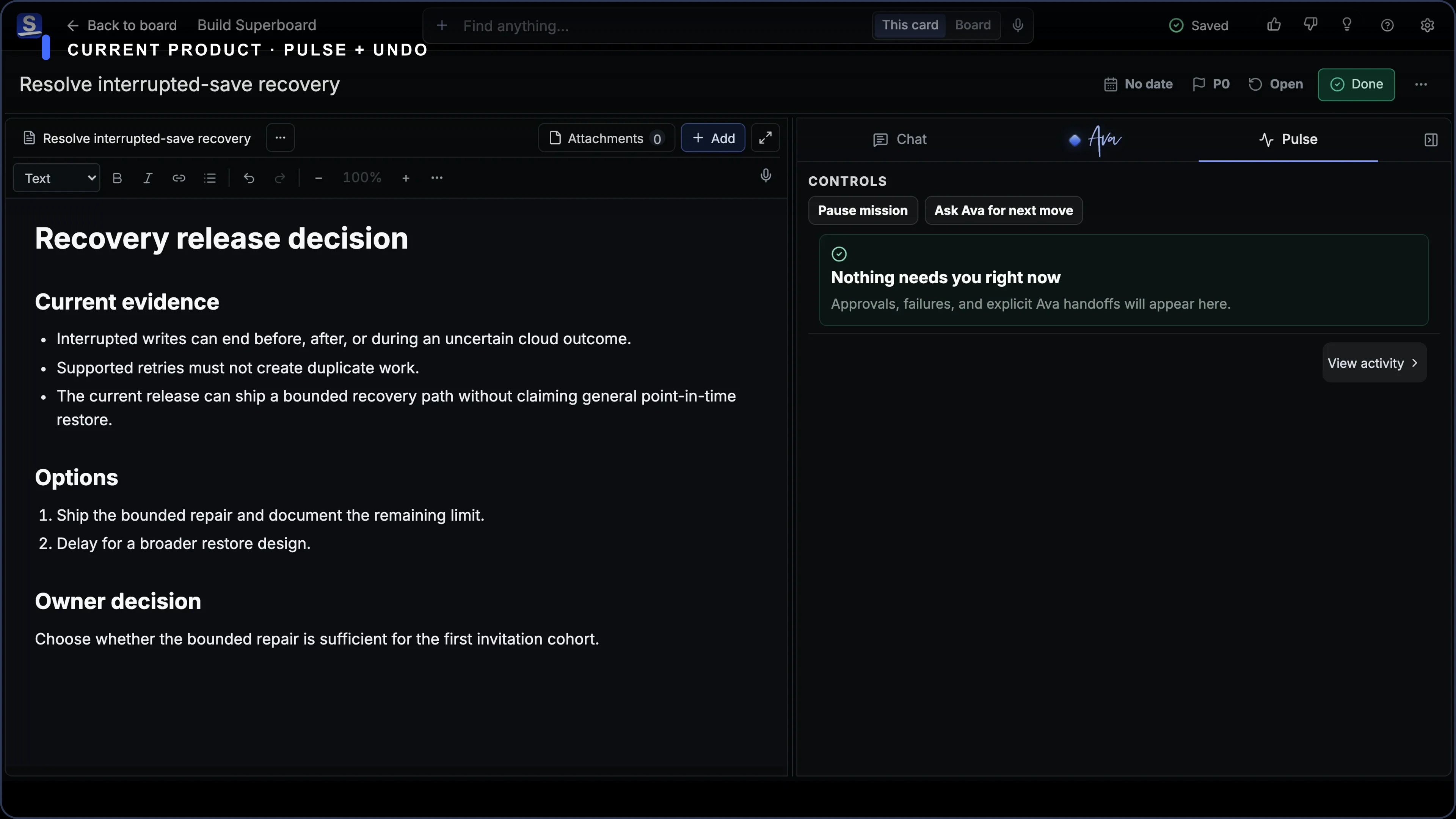
Undo reverses supported actions while you work.
Removed Items lets you bring back removed Cards, Lists, and Boards.
General point-in-time rollback for a Card or Board is product direction, not a current promise.
Available today
Ways back that exist today
Availability depends on the action and surface. If Superboard does not show an Undo or restore control for a change, do not assume that change can be rolled back.
| Protection | What it does | Use it when |
|---|---|---|
| Undo | Reverses a supported recent action | A supported move, edit, or AI action was wrong |
| Restore from Removed Items | Brings back a removed Card, List, or Board | Work was removed but should remain active |
| Preserved recovery copy | Keeps certain conflicted or interrupted versions available | A save conflict would otherwise risk losing local work |
Why AI makes recovery more important
AI can organize, draft, and change work faster than a person. That creates leverage, but it also increases the amount that can change before someone notices. Visibility tells you what happened; recovery gives you a practical response.
An Owner can delegate supported work to Ava more confidently when meaningful changes are attributed and an earlier state remains available. The goal is not to prevent every mistake. It is to keep mistakes from becoming permanent loss.
Honest sync includes unknown outcomes
A save can fail before reaching the cloud, fail after reaching it, or lose its response while the result is uncertain. Those are different states. Superboard should not tell the Owner that work is saved when it is not, or blindly retry an uncertain mutation and create a duplicate.
Current safeguards preserve local edits, show saving or failure state, and use canonical reads or deterministic identity where a write outcome must be checked. The exact protection depends on the operation; recovery is never inferred from optimism.
Attribution makes recovery usable
Undo is more trustworthy when the Owner can see what changed, who or what changed it, and which object will be restored. Activity supplies the chronological record; recovery controls supply the way back. One without the other leaves either an unexplained change or an unexplained reversal.
This matters for human edits and AI-supported edits alike. Ava’s supported mutations are meant to remain visible, attributed, and reversible rather than silently rewriting the mission.
The Owner still decides what the intended state should be, whether an available Undo or restore is appropriate, and whether the recovered result is correct. Honest save state and attribution provide the evidence for that judgment; they do not make every change reversible or make the decision on the Owner’s behalf.
Direction
Point-in-time history and deeper recovery
Superboard’s direction includes reliable point-in-time history and restore behavior across documents, checklists, future canvases, Cards, and whole Boards. That broader time-capsule promise is not yet available as a general customer control.
Recovery will deepen as Superboard adds more native artifacts and live team editing. Current controls in the product remain the source of truth for what can be reversed today.