Learn
When Ava acts as herself—and when she acts for you
A useful assistant needs an identity people can understand. It also needs a truthful delegation boundary when a service only works by acting through the person’s account or when the resulting promise belongs to the person.
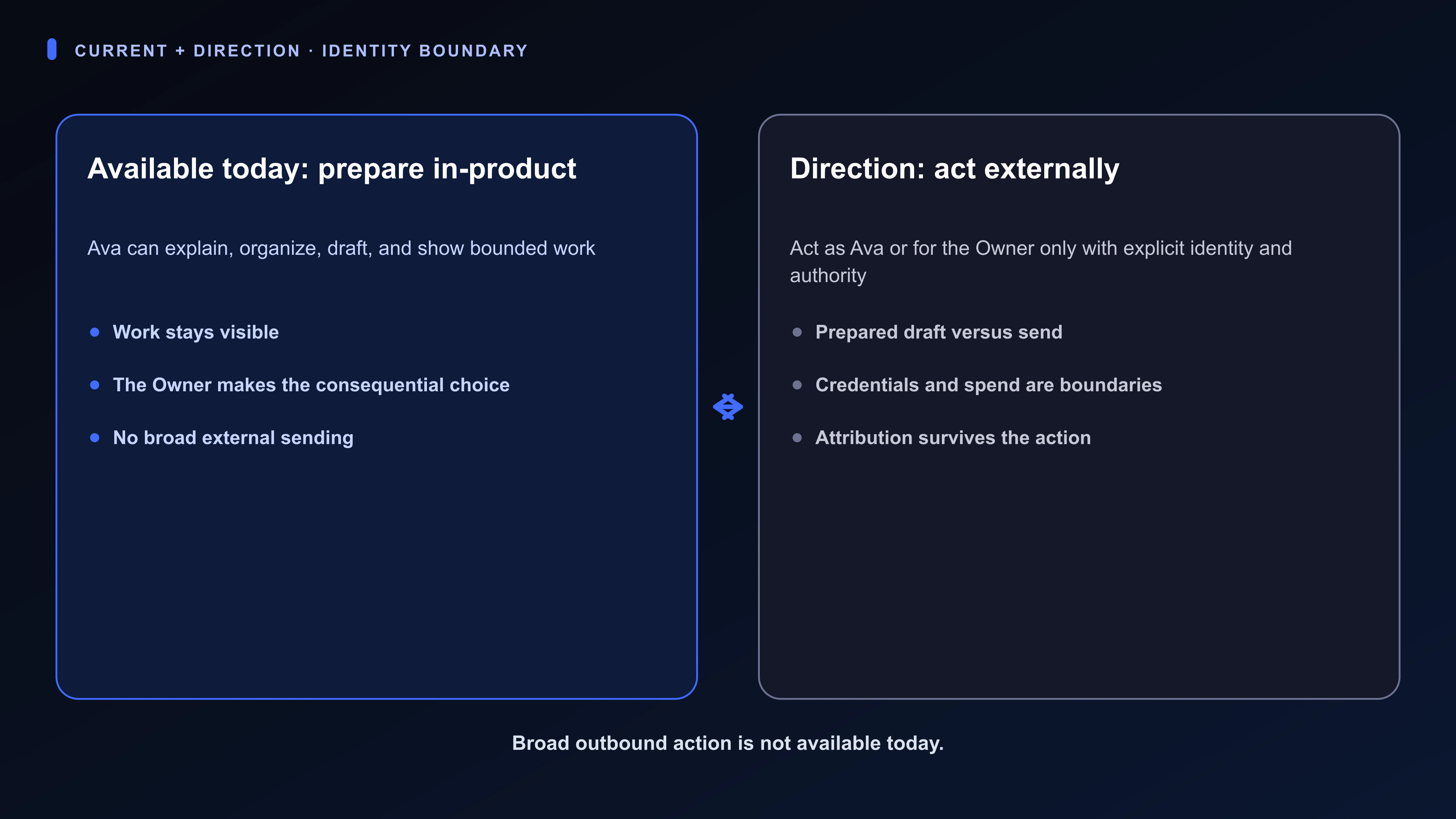
Available today: drafts, attributed supported internal work, and configured @Ava Card Chat—not broad assistant-owned email or general send authority.
Direction: appropriate assistant-owned communication and governed action through customer connections, with identity, authority, sent content, and outcome recorded on the Card.
Identity never removes the Owner’s responsibility for consequential promises.
The current boundary before the identity model
The three communication states below explain the identity model; they are not all current Superboard capabilities. Today, Superboard preserves drafts and attributed bounded work. Broad assistant-owned outbound communication, send-as-the-person authority, spending, and arbitrary customer-account execution are not available.
Three different communication states
| State | What the recipient should understand | Typical boundary |
|---|---|---|
| Ava communicates as Ava | An assistant prepared and sent this communication | Assistant-owned channel and approved scope |
| Ava prepares for the Owner | The Owner reviews and sends the final message | Drafting without send authority |
| Ava acts through the Owner's account | The account belongs to the Owner | Explicit connection, grant, evidence, and consequence checks |
Available today
Available today: drafts and bounded product actions
Current Superboard can preserve drafts and discussion in Card Rooms, attribute Ava’s supported internal work, and accept explicit @Ava requests in Card Chat when the provider path is configured.
It does not currently provide broad assistant-owned email, general send-as-the-person authority, spending, or arbitrary customer-account execution.
A prepared send is stronger than a surprise
For a consequential message, Ava should gather the relevant history, draft the response, identify the promise being made, surface uncertainty, and recommend a choice. The Owner can then decide with the work already done.
A remembered preference or Co-owner posture does not silently convert a draft into send authority.
Direction
Direction: governed identity across real tools
The direction includes assistant-owned communications where appropriate and governed action through customer connections where necessary. The Card records which identity acted, what authority applied, what was sent, and whether the outcome is known.
The product should make the identity boundary legible without forcing the person to administer a policy matrix for every task.