Learn
Why AI should guide you instead of waiting for the perfect prompt
A blank box is flexible, but it makes the person frame the problem before the AI can help. In Superboard’s direction, Ava offers three honest doors into a mission: guide the next decision, name the intent as work, or accept the messy dump and find structure with you—whether the mission is an exam, insurance, dinner, or life admin.
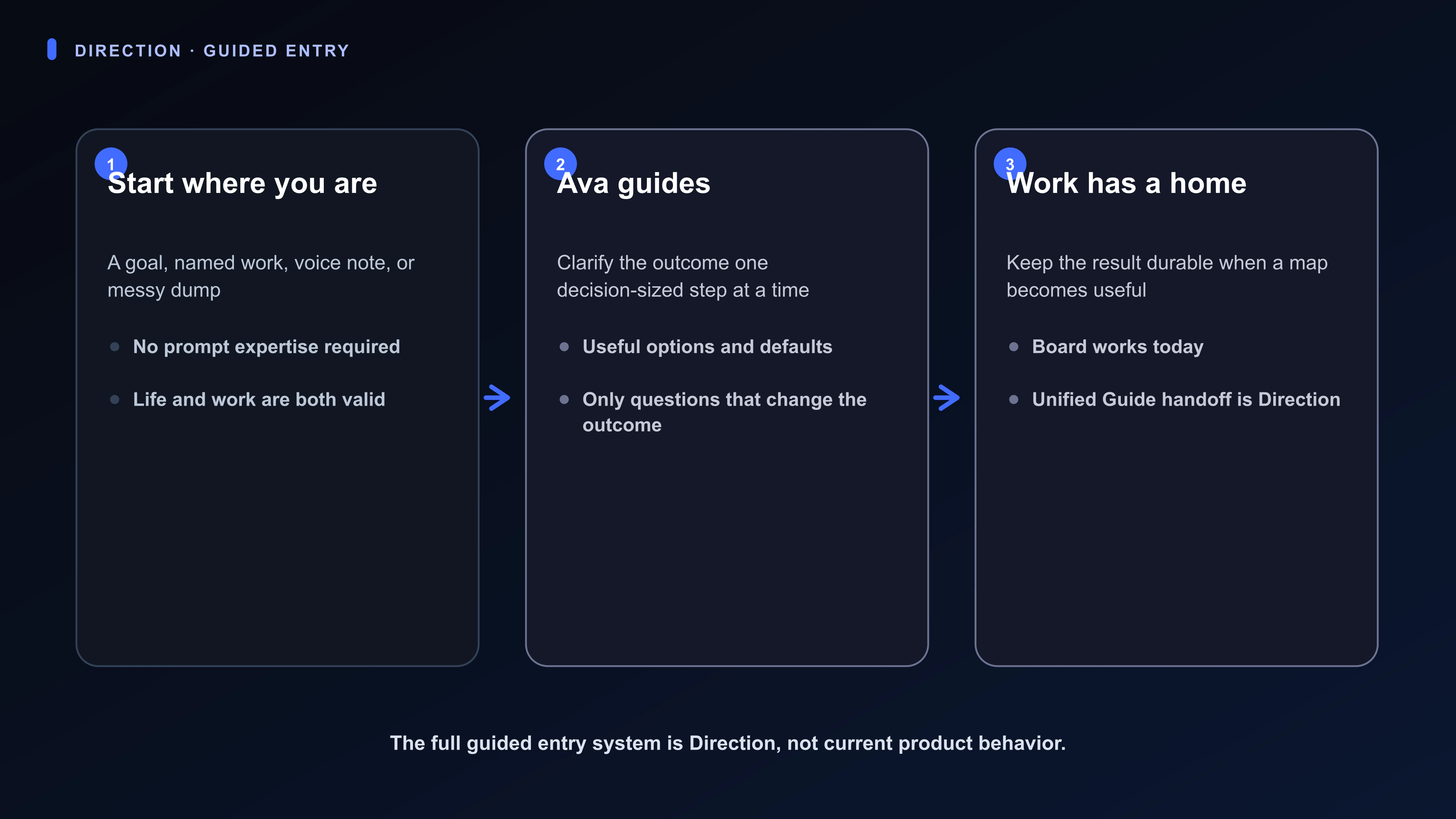
Blank prompts reward people who already know the right question, vocabulary, and level of detail.
Guidance should reduce framing work through choices, defaults, one question at a time, and an escape hatch for unstructured context.
The complete Guide-and-Board experience is Direction; current Superboard remains a Board-first product with bounded Ava help.
The blank box moves the hardest work onto the person
‘Ask anything’ sounds generous. It also assumes you can name the problem, choose the right scope, supply the relevant context, and recognize a good answer. That works well when the question is already clear. It fails precisely when someone is overwhelmed, unfamiliar with the domain, or unsure what decision comes next.
A student trying to crush an exam may not know whether to ask for a schedule, a diagnostic quiz, or a study method. Someone buying insurance may not know which coverage tradeoff matters. Someone choosing dinner may only know they are tired and low on groceries. A person staring at a pile of life admin may not have a prompt at all.
Guidance should make the next decision smaller
Guided AI does not mean trapping someone in a wizard. It means using what is known to offer a few legible choices, one useful default, or one question whose answer would materially improve the plan. The person can accept, change, skip, or explain in their own words.
Good guidance preserves agency. It does not pretend there is only one correct path, bury consequential choices, or keep asking questions after the cost of another answer exceeds its value.
If the best next move is ‘none of these,’ the person should be able to skip the choices or type the real situation in their own words. Guidance fails when it prioritizes finishing the script over improving the decision.
Direction
Three doors into the same mission
These are three doors into one product and one Ava, not three assistants or three apps. They are product direction, not a claim about today’s default screen. Ava helps the person move from ambiguity to a useful next step while the resulting mission state stays durable.
| Door | When it helps | Example |
|---|---|---|
| Guided flow | The person needs help understanding the decision | Compare insurance coverage through a few meaningful tradeoffs |
| Named intent | The outcome is clear enough to become durable work | Create a Card for ‘Crush the chemistry final’ and shape the study plan |
| Unstructured dump | The person has context but no clean frame | Paste the anxious pile of renewals, errands, messages, and deadlines |
Direction
Board mode remains available when the map becomes useful
In the intended product, the person should not have to open or manage a Board to receive meaningful help. Guide mode is a complete experience for choosing dinner, untangling a small decision, or advancing one step in a larger responsibility—not a trial mode that expires into a Board.
When the work gains parts, artifacts, commitments, or a longer lifecycle, Board mode reveals the operating picture. The durable state is the same. Board mode is optional depth, not a graduation ceremony or an expert interface hidden behind the friendly one.
Available today
What Superboard provides today
Current Superboard is Board-first. A signed-in Owner can create and switch Boards, capture flexible Cards, open Card Rooms, create Documents and Checklists, attach Files, and use Chat. Ava help is bounded: supported Board actions and explicit card mentions when configured—not an always-on guide across every mission.
That current foundation can hold the work once it is named. It does not yet provide the complete unified Guide mode, three-door entry system, shared personal Memory Spine, or an Ava that proactively guides every mission across the account.
Guidance is a design discipline, not more conversation
A good guide helps the person see the decision, understand the tradeoff, and move. Sometimes that means a question. Sometimes it means a prepared comparison. Sometimes it means accepting a messy dump without scolding the person for its shape.
The standard is not longer chat. It is a smaller next decision, intact agency, and durable work the person can still recognize tomorrow—on the Board when the map helps, without requiring the Board when it does not.