Learn
Why the plan and the work belong together
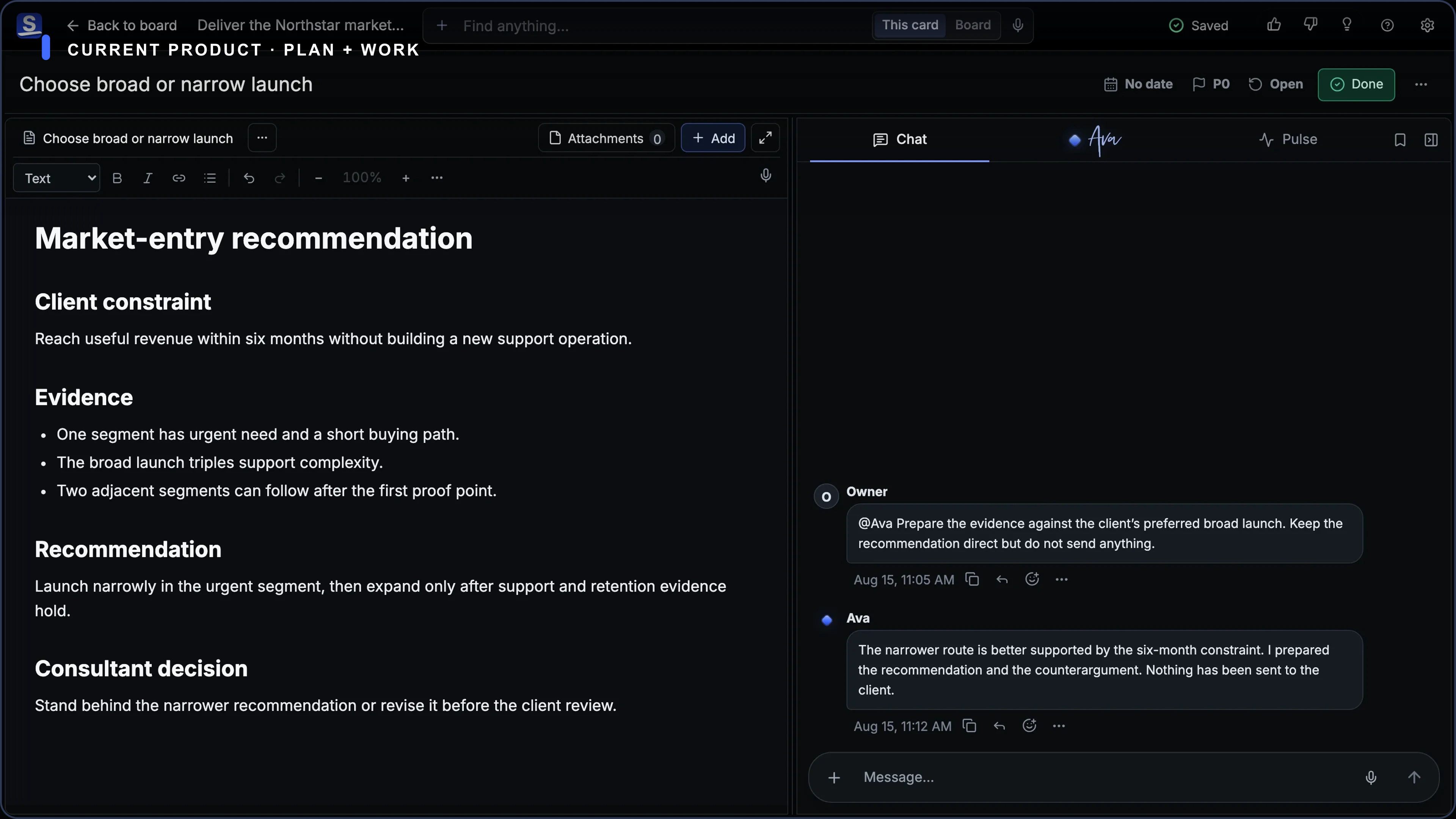
A plan explains why the work matters. The artifact reveals what the plan has become. Separate them and each loses truth. Superboard’s Card Room keeps the assignment, working material, conversation, attention, and record attached to the same piece of work.
A detached plan becomes a stale description of work happening somewhere else.
A detached artifact loses the decisions, constraints, and purpose that make it useful.
A Card Room keeps Stage, Chat, Pulse, and Activity with the work; richer creation runtimes remain Direction.
The handoff between planning and doing is where context disappears
A customer estimate may begin as a conversation about scope and risk, become a checklist of measurements, and end as a document someone must stand behind. A household repair may begin with a leak, branch into photographs and quotes, and end with a decision about cost and timing. When each step lives in a different tool, returning to the work means reconstructing the story.
The plan ages in one place while the artifact changes in another. Decisions get buried in chat. The final file looks complete but no longer explains the tradeoffs inside it. The problem is not missing productivity features. It is missing continuity.
Available today
The Card names the work; the Room holds its reality
In Superboard today, a Card can represent a task, decision, customer, appointment, reference, asset, prompt, or loose thought. Opening it reveals a full-page Room. Stage holds the working artifacts. Chat holds the thread beside them. Pulse separates the Card’s current state, items needing Owner attention, and recent meaningful changes from the full Activity history. Activity keeps the complete attributed record of what changed.
That structure keeps the assignment and its evidence in the same place. A Card called ‘Send Oak Street estimate’ can hold the estimate Document, a site-photo File, a Checklist of details to confirm, the conversation around price, and the history of what changed.
Available today
What you can create in Stage today
A Room can hold an ordered mix of these artifacts and keep one in focus at a time. Document and Checklist edits remain available on the device while a save finishes, so the working draft does not depend on a perfect connection. When private cloud storage is configured, Files attach the same way Chat attachments do.
| Artifact | Useful for |
|---|---|
| Document | The estimate, specification, letter, decision note, or repair plan itself |
| Checklist | Concrete steps, confirmations, and dated targets that belong to this work |
| File | Photographs, source material, audio, video, and other supporting evidence |
Chat becomes useful when it stays beside the artifact
Consider a difficult email. The important work is not only drafting sentences. It is remembering the relationship, the commitment already made, the consequence of the wrong tone, and the decision the message must ask for. Keeping the draft and its conversation together makes review more honest.
The same applies to a product specification. A specification without its open questions becomes false certainty. A discussion without the current specification becomes abstract. The Room lets the artifact and the reasoning correct each other.
Direction
Direction: more kinds of work, still attached to the Card
Direction for Stage includes richer native runtimes—slides, sheets, canvases, websites, browsers, meetings, and automations. None of those surfaces are available today.
The principle remains stable even as the artifact changes: the plan, conversation, deliverable, decisions, and evidence keep a durable home. A richer tool should deepen the Room rather than send the mission back into disconnected tabs.
A practical rule
If changing the artifact could change the plan—or a decision in the plan could change the artifact—they belong together. Use one Card Room until the work becomes a genuinely separate outcome with its own context and lifecycle.
This is less about storing everything in one screen than preserving the thread of meaning. You should be able to return tomorrow and understand what the work is, why it looks this way, what needs judgment, and what happened while you were away.