Compare
Superboard vs. Slack and Teams: conversation or mission home?
Slack is built for fast team communication. Superboard is built to hold the initiative and its work. Those are different jobs, and many teams may eventually use both.
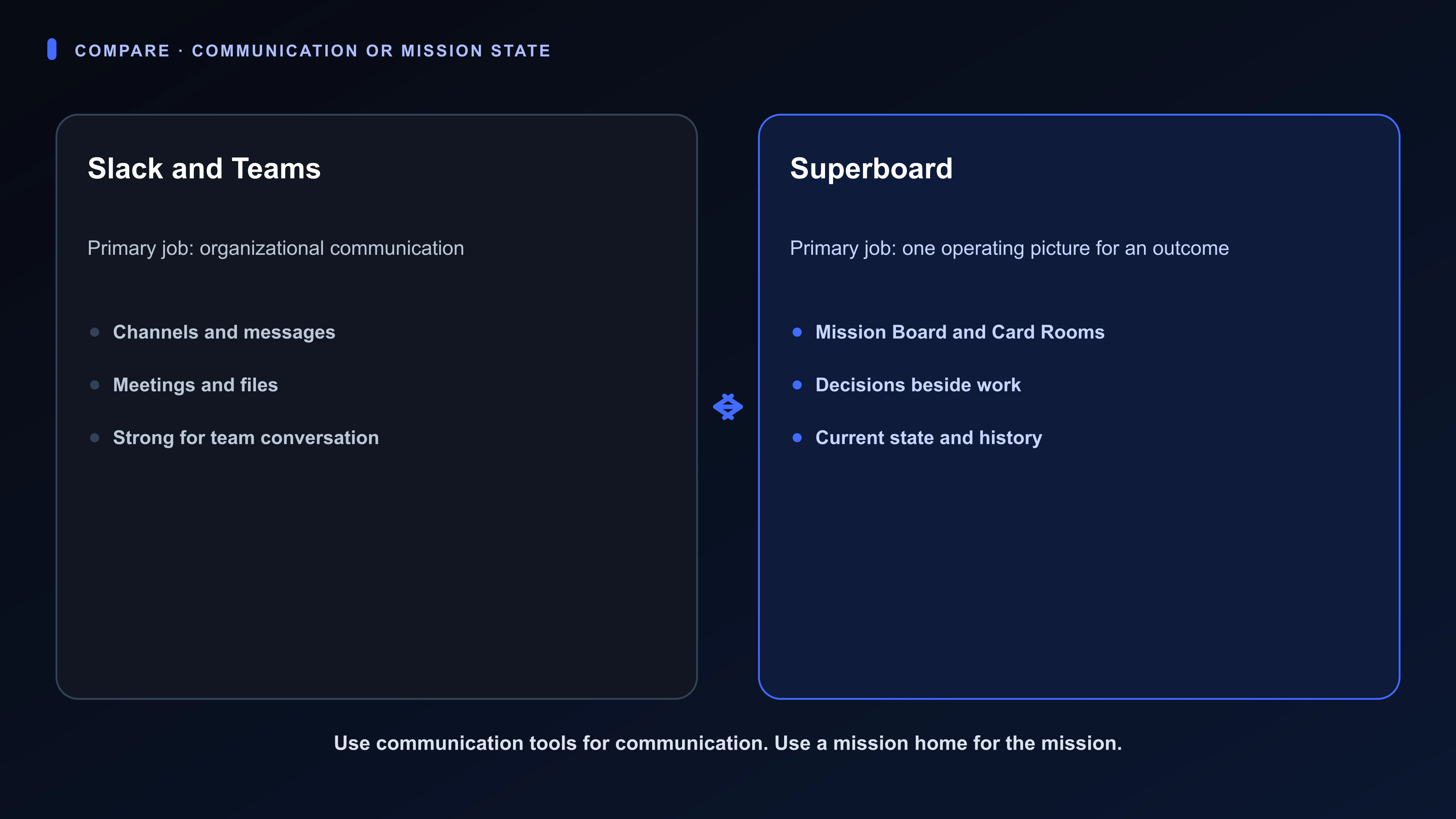
Choose Slack when high-volume live team communication is central.
Choose Superboard when the initiative needs durable structure; the Owner still holds its mission, constraints, consequential decisions, and external authority.
Superboard is solo-first today. Real-time small-team collaboration is Next; direct Slack or Teams connections, production multi-agent work, and broader rollback are Direction.
The shortest useful comparison
| Dimension | Slack | Superboard |
|---|---|---|
| Primary organizing unit | Channels and messages | A Board for the whole initiative; Cards open into Rooms |
| Central job | Slack is especially strong for real-time team communication across channels, direct messages, huddles, workflows, apps, and canvases. Microsoft Teams similarly centers teams and channels where conversations, meetings, files, and apps come together. | Keep the operating picture, work, judgment, Ava, and history together |
| AI role | AI supports search, summaries, writing, and work inside Slack surfaces | Ava works inside the Board and its Rooms; the broader multi-agent workforce is Direction |
| Human judgment | Decisions are handled through messages, canvases, workflows, and team conventions | Pulse keeps contextual changes and questions with the work; cross-Board decision ranking is Direction |
| Current collaboration | Mature channels, direct messages, huddles, canvases, workflows, and apps | Solo-first; real-time small-team collaboration is Next |
| Recovery and history | History and restore behavior depend on the surface, retention settings, and plan | Visible Activity, supported Undo, and restore from Removed Items; broader point-in-time rollback is Direction |
What Slack does especially well
Slack is especially strong for real-time team communication across channels, direct messages, huddles, workflows, apps, and canvases. Microsoft Teams similarly centers teams and channels where conversations, meetings, files, and apps come together.
- An established team needs real-time messaging and meetings now.
- Channels and direct messages are the central collaboration layer.
- A mature communication, administration, and integration ecosystem matters.
What Superboard organizes differently
Slack and Teams organize the conversation layer: channels, messages, meetings, files, and fast coordination. Superboard organizes the outcome those conversations are trying to move. The Board is the mission map; each Card opens a Room where its artifact, decision, Chat, Pulse, and Activity remain attached.
A home-repair mission might keep quotes, the contractor decision, warranty, appointment, and history on one Board while messages stay in Slack or Teams. A product launch might keep its release artifact and go/no-go decision in a Card Room while the team coordinates elsewhere. Superboard's shared small-team layer is Next, so the products compose more honestly than they replace one another today.
Keep the product boundary clear
The Owner keeps the mission, its constraints, every consequential decision, and authority outside Superboard’s current supported actions. Use this memory aid: people together is Next—real-time small-team collaboration. Systems working more broadly is Direction—direct integration, production multi-agent work, cross-Board decision ranking, and broader point-in-time rollback. Neither is available today.
When to choose Slack
- An established team needs real-time messaging and meetings now.
- Channels and direct messages are the central collaboration layer.
- A mature communication, administration, and integration ecosystem matters.
When to choose Superboard
- One Owner needs the outcome to survive beyond message flow and meeting history.
- Artifacts, commitments, decisions, current state, and the attributable record need one durable home.
- Slack or Teams can remain the communication layer while Superboard holds the mission; realtime Superboard collaboration is Next.
How they can work together
Slack or Microsoft Teams can remain the fast communication layer while Superboard becomes the canonical place for the mission, artifacts, and decisions. Direct Slack and Teams integrations are Direction, not current claims. The products are separate and are not affiliated.
Available today
Current Superboard limits
Superboard is solo-first and has no current realtime team layer or direct Slack or Teams connection. Use the communication product for live team coordination today; small-team Superboard collaboration is Next.
Official sources
Material claims about the other product were checked against these first-party sources on 2026-08-16.