Example
From sticky notes to a living visual system
Riley’s sticky notes work because they stay visible. They fail when thirty small promises become one unsearchable wall. The answer is not to shame the paper; it is to keep the visual field and give each important note somewhere deeper to live.
This fictional example was created with AI assistance from a structured editorial brief and reviewed for reader usefulness and product truth before publication.
Riley is a fictional example, not a customer or testimonial.
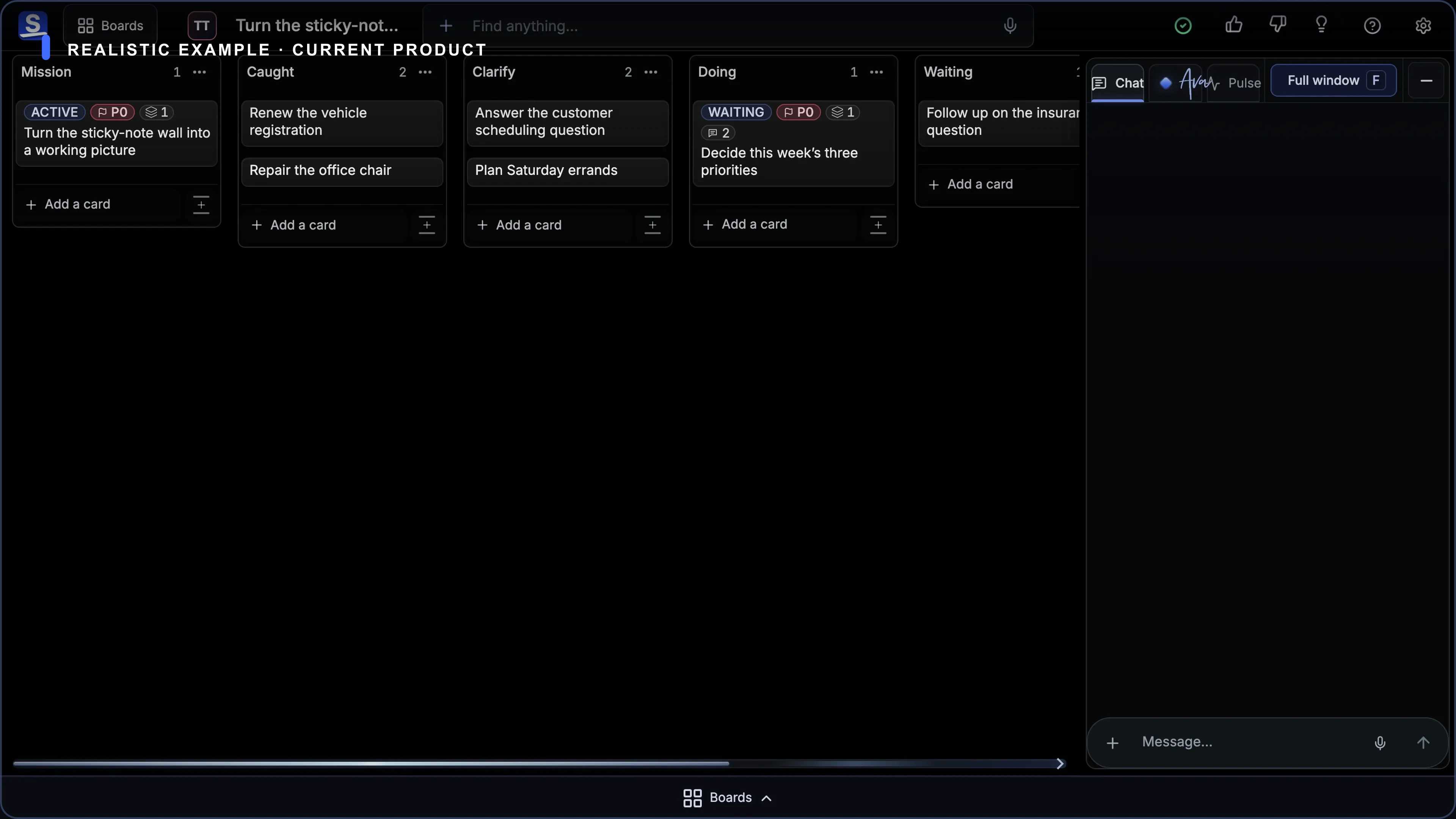
The Board keeps open loops visible and movable; each important Card can hold the context, artifact, conversation, state, and history behind the note.
Current Superboard does not automatically capture paper notes, remind Riley about everything, or decide what matters. The Owner still chooses the priorities.
The notes already know something digital lists often forget
A living visual system starts with what a sticky note already does well: it stays in sight, it can be touched, it can be written in a few seconds, and it can be moved to a new place without a form. The move to Superboard is to keep that visual field and give each important note a Room where its meaning can survive. Riley, a fictional 38-year-old in Calgary who manages a small service team and a household, uses notes for that reason. The monitor is ringed with them because a hidden list does not interrupt a crowded morning the way a yellow square at eye level does.
The pressure is not that Riley is disorganized. The notes succeed at capture. Renew the registration, answer the insurance question, repair the chair, plan Saturday errands, call a customer, choose the week’s priorities: each one is a real promise, and each one can be peeled up and stuck somewhere else in a second. The wall becomes the problem when thirty small promises occupy the same visual rank, and there is no durable place for the meaning behind any of them.
Honor the paper before asking more of it
Visibility is the first virtue. A note on the bezel is in the room. It does not require opening an app, remembering a list name, or scrolling past yesterday’s grocery run. Riley can look up from a customer call and see that the registration is still there.
Tactility is the second. The adhesive, the handwriting, the slightly crooked angle, the act of peeling a note off and pressing it somewhere else all make the work feel real. A digital row that never changes shape is easier to ignore. Immediacy is the third. There is no login and no required field. A thought becomes an object before it has been categorized. Easy movement is the fourth. The whole point of the wall is that a note can travel from “must do today” to “waiting on someone” by moving three inches.
Those virtues are why the wall lasted. The failure is narrower and more honest than “paper is old-fashioned.” Riley cannot search the wall. A note that falls behind the desk leaves no history. Rewriting a crowded square destroys the previous wording. There is no attached insurance email, no customer detail, no record of who is waiting, and no way to tell whether Saturday’s errands were already handled. The paper is still good at being present. It is poor at remaining true after the week changes.
Available today
Keep the field; add durable depth
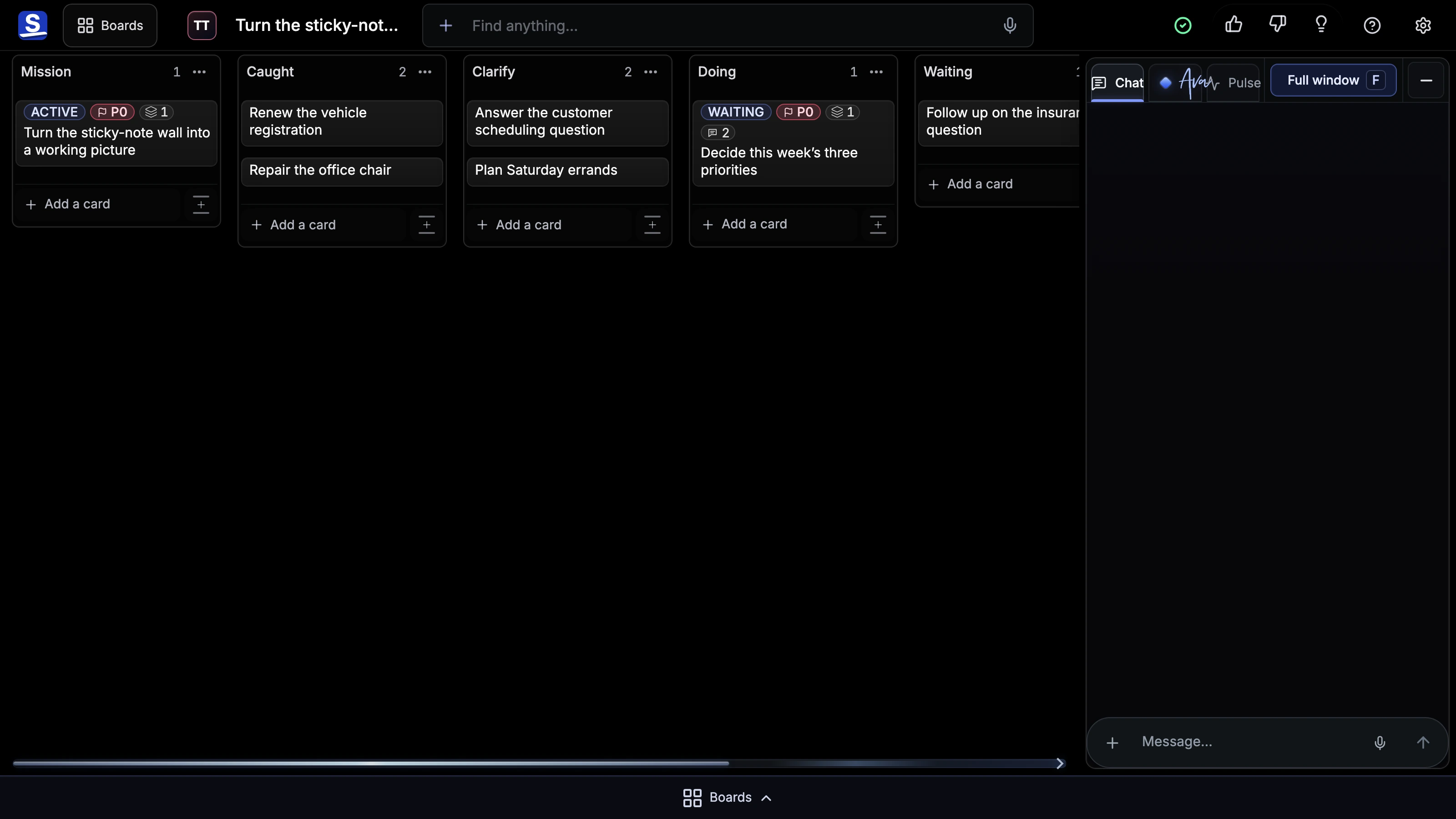
Riley’s fictional Board keeps the glanceable field and refuses to begin with a database. Lists are named Caught, Clarify, Doing, Waiting, and Done, with a Mission Card that says the job plainly: make every real open loop visible without treating every note as equally urgent. The first pass is intentionally loose. A Card can be a task, a decision, an appointment, a reference, or an idea, so capture does not require designing a taxonomy before the work is understood.
Renew the vehicle registration and Repair the office chair can sit in Caught as soon as they leave the paper. Answer the customer scheduling question may need a verb and a date before it is honest. Follow up on the insurance question belongs in Waiting once Riley notices it is not Riley’s next physical action. Plan Saturday errands can stay visible without occupying the same rank as a Friday deadline. Decide this week’s three priorities is the Card that makes the wall honest instead of merely busy.
The Board is still movable. The difference appears when a note matters enough to open. Its Room can hold a Document or Checklist, File references, Chat, Pulse, and Activity. Search can find the insurance question later. Supported Undo and Removed Items mean a mistaken close is recoverable. That is what durable digital state adds: not a scolding replacement for paper, but a place for context, history, and recovery after the adhesive fails.
One decision replaces five competing notes
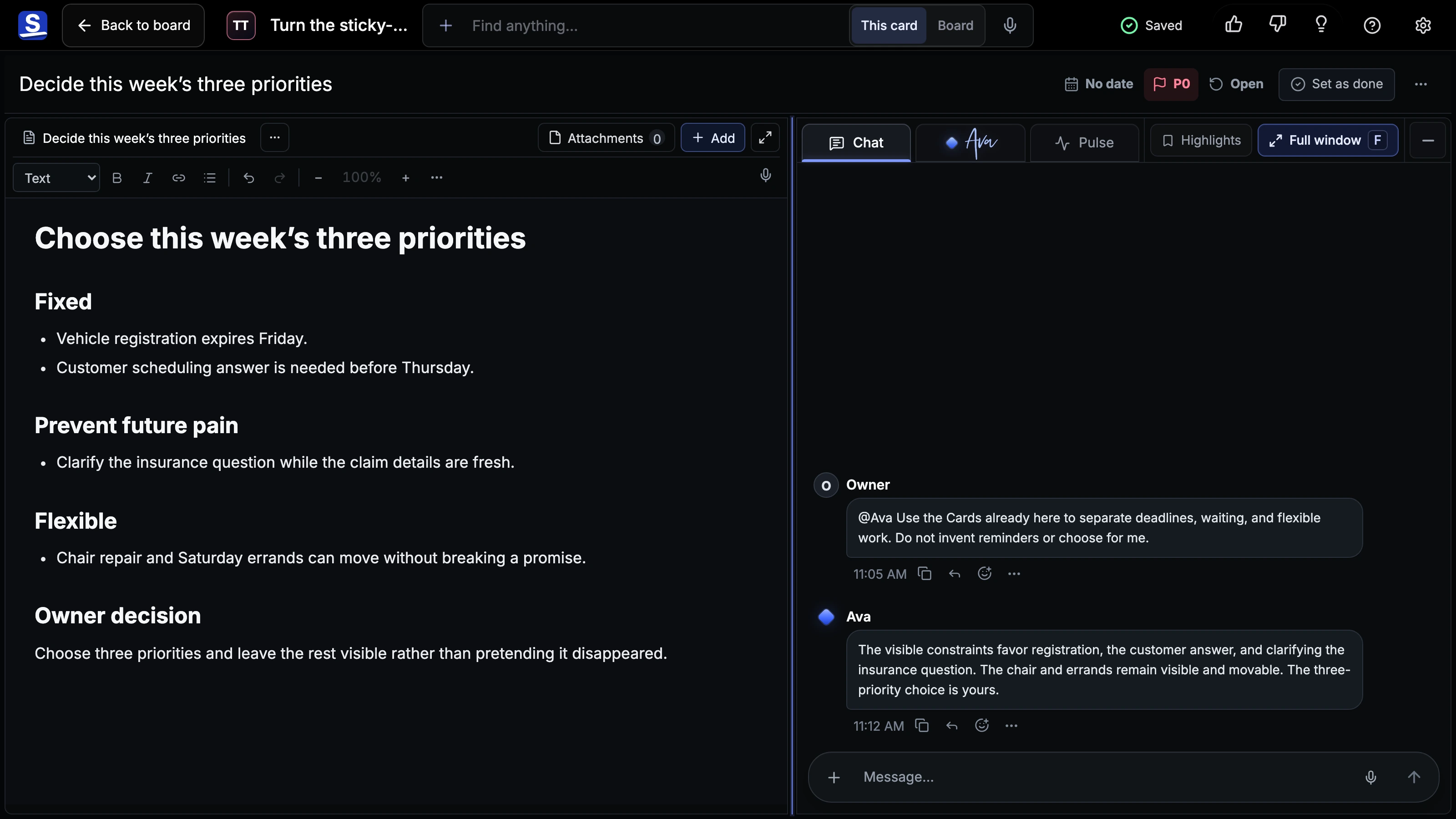
The consequential Card is Decide this week’s three priorities. Its Room collects the fixed commitments, the work that prevents future pain, and the tasks that merely feel loud. Vehicle registration expires Friday. The customer scheduling answer is needed before Thursday. The insurance question is waiting on another person while the claim details are still fresh. The chair repair and Saturday errands can move without breaking a promise. None of that ranking was visible when every note had the same bright square.
Riley can ask Ava, explicitly, to use the Cards already on the Board to separate deadlines, waiting, and flexible work—and not to invent reminders or choose the week. The response stays beside the brief. Pulse shows that the Card is waiting for the Owner. Activity records that the preparation happened and that the choice did not. Riley still peels the metaphorical notes into Doing, Waiting, or later in the week.
The outcome is modest on purpose. It is one defensible week: three priorities chosen, waiting work separated from active work, and everything else still visible without occupying the same mental rank. The wall did not become a perfect life system. It became a picture Riley can trust after Friday, which is the thing paper could not do once the notes multiplied.
Available today
Where Ava helps—and where she does not
Riley can explicitly ask Ava to summarize the Cards already on the Board, identify a visible deadline or waiting state, or help reorganize supported Board items through bounded undoable actions. Ava can reduce the reconstruction work when the relevant state is already present. That is useful on a Sunday night when the wall has grown faster than Riley’s patience for rewriting it.
Ava does not currently read the paper notes, watch Riley’s life, capture the wall by camera, create comprehensive reminders, or know which commitment matters more without the Owner’s constraints. Superboard does not decide that the chair is unimportant. Riley supplies the purpose and makes the consequential priority call. The product should not be asked to shame the notes or to nag in their place.
A ten-minute migration recipe
The recipe is for a first pass, not a lifestyle overhaul. If a note is already done, it does not need a Card. If a note is really two promises, it can become two Cards later. Depth is earned. Most notes can stay thin. Only the ones that keep losing their meaning need a Room.
| Step | Action |
|---|---|
| 1. Capture | Create one Card per live note; do not rewrite or categorize yet |
| 2. Remove | Delete duplicates and anything that no longer represents a promise |
| 3. Clarify | Give unclear Cards a verb, outcome, date, or waiting state |
| 4. Deepen | Open a Room only when the item needs evidence, conversation, or an artifact |
| 5. Choose | Move a small current front into Doing and leave the rest visible |
| 6. Close | Use Done and Activity so completion does not depend on memory |
Direction
Direction is deeper orientation, not a nagging wall
Direction is for Ava to help introduce structure when the work needs it, carry relevant context across days, notice when the Owner is stuck, and prepare clearer next choices through the same product. That is different from generating more reminders or interrupting Riley with an AI overlay on the physical desk.
Continuous personalized memory and proactive cross-product orientation are Direction, not capabilities demonstrated by this current fixture. Riley remains a fictional example. The page does not claim that Superboard has replaced anyone’s sticky-note wall or measured a result from doing so.