Example
How Joshua uses Superboard to run You.one without losing the rest of life
Joshua did not need another place to collect tasks. He needed a visual operating picture he could trust after the sticky note came off the monitor, the chat ended, or the week changed. This is the real working pattern, reconstructed without exposing his private production Boards.
This article is based on Joshua’s real operating pattern, reconstructed for privacy with AI-assisted drafting and reviewed for product truth before publication.
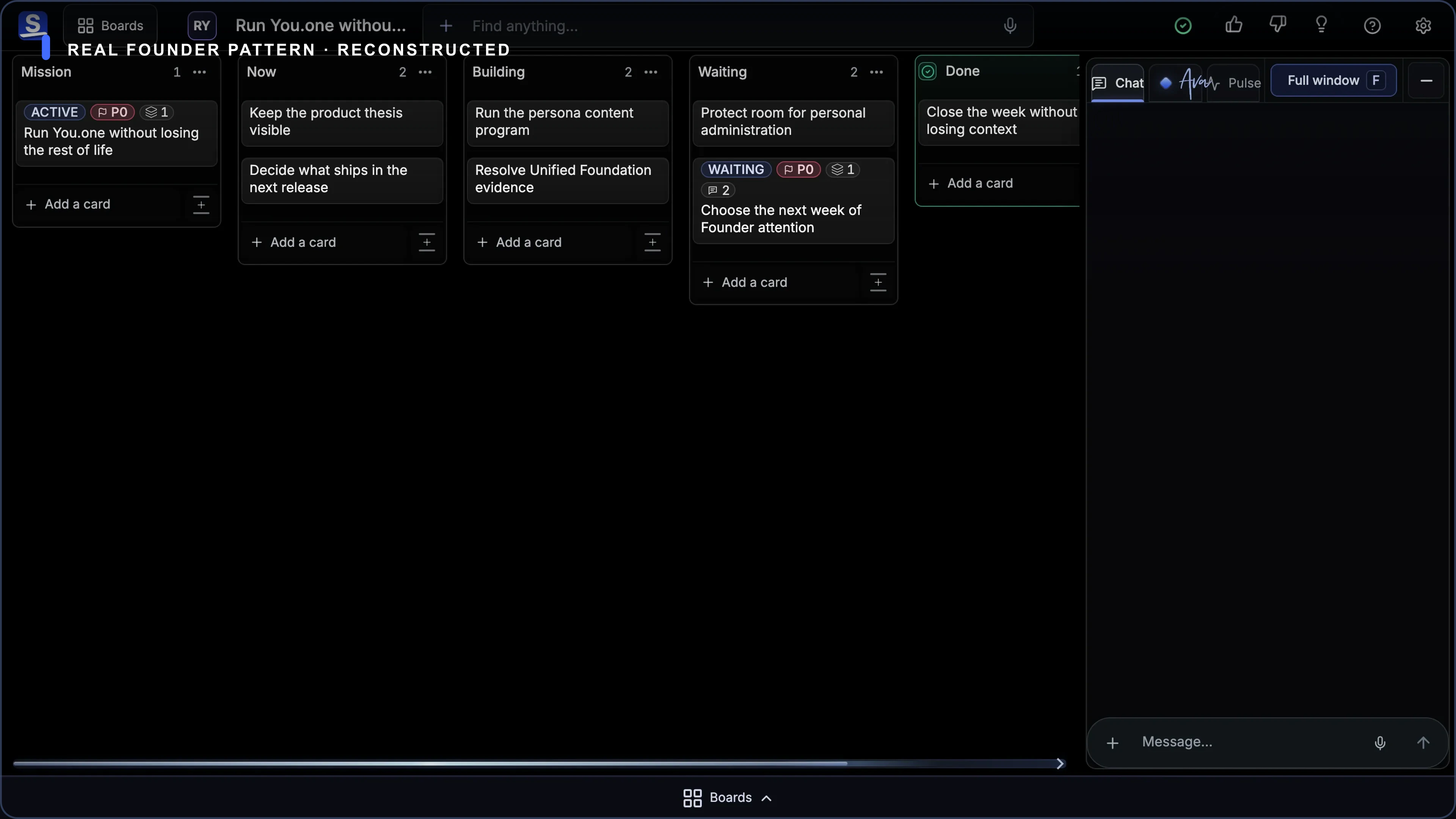
This is a real Founder use pattern, but the public Board is a labeled reconstruction—not a copy of Joshua’s private account.
Separate Boards keep different missions legible; flexible Cards and their Rooms preserve the decision, work, conversation, and history behind each visible item.
Current Superboard provides the durable visual workspace and bounded Ava help shown here. One unified Ava carrying context across You.one and every Board remains Direction.
The company cannot live only in Joshua’s head
Joshua uses Superboard to run You.one as a visible mission, not as a private mental inventory. The product thesis, the next release, foundation evidence, the content program, and the personal administration that still has to happen this week all need a picture he can scan after a sticky note comes off the monitor, a chat ends, or the calendar turns. That is the pressure: Founder attention is finite, and memory is a poor operating system for a company and a life at once.
He already knew how to collect work. Years of Trello use produced thousands of Cards. The collection grew until history itself became a problem: older work still mattered, but the current picture was no longer trustworthy at a glance. Sticky notes on the computer were not a quirk. They were an interrupt that a hidden list could not provide. The failure was what happened next. Once the note moved, multiplied, or came off, the reason it existed usually disappeared with it.
Superboard is the command-center face he built so the visible item and the durable work could be the same thing. The public page below is not his private account. It is a labeled reconstruction of the operating pattern: keep the mission in sight, separate now from longer building, preserve waiting instead of carrying it in memory, and give the week’s real attention choice a Room.
A real pattern, reconstructed for privacy
Joshua’s actual Founder Boards contain private company strategy, security-sensitive work, personal information, and conversations that do not belong in marketing material. Nothing on this page is a screenshot of production data, a customer result, or a quotation from those Boards. Names, details, and the specific week shown here are sanitized or reconstructed so the pattern can be taught without exposing the person or the company.
The reconstruction still has to be specific enough to be useful. It shows one mission slice: build You.one with urgency without making Joshua’s memory the system of record. Adjacent private Boards for other parts of life and for Superboard itself are part of the real pattern and are not displayed. One account can hold those separate pictures; this page only opens the reconstructed You.one operating Board.
Read every Card, date, and Chat line here as a public-safe stand-in. The structure is faithful. The contents are not a tour of the private record.
Available today
One Board for the current operating picture
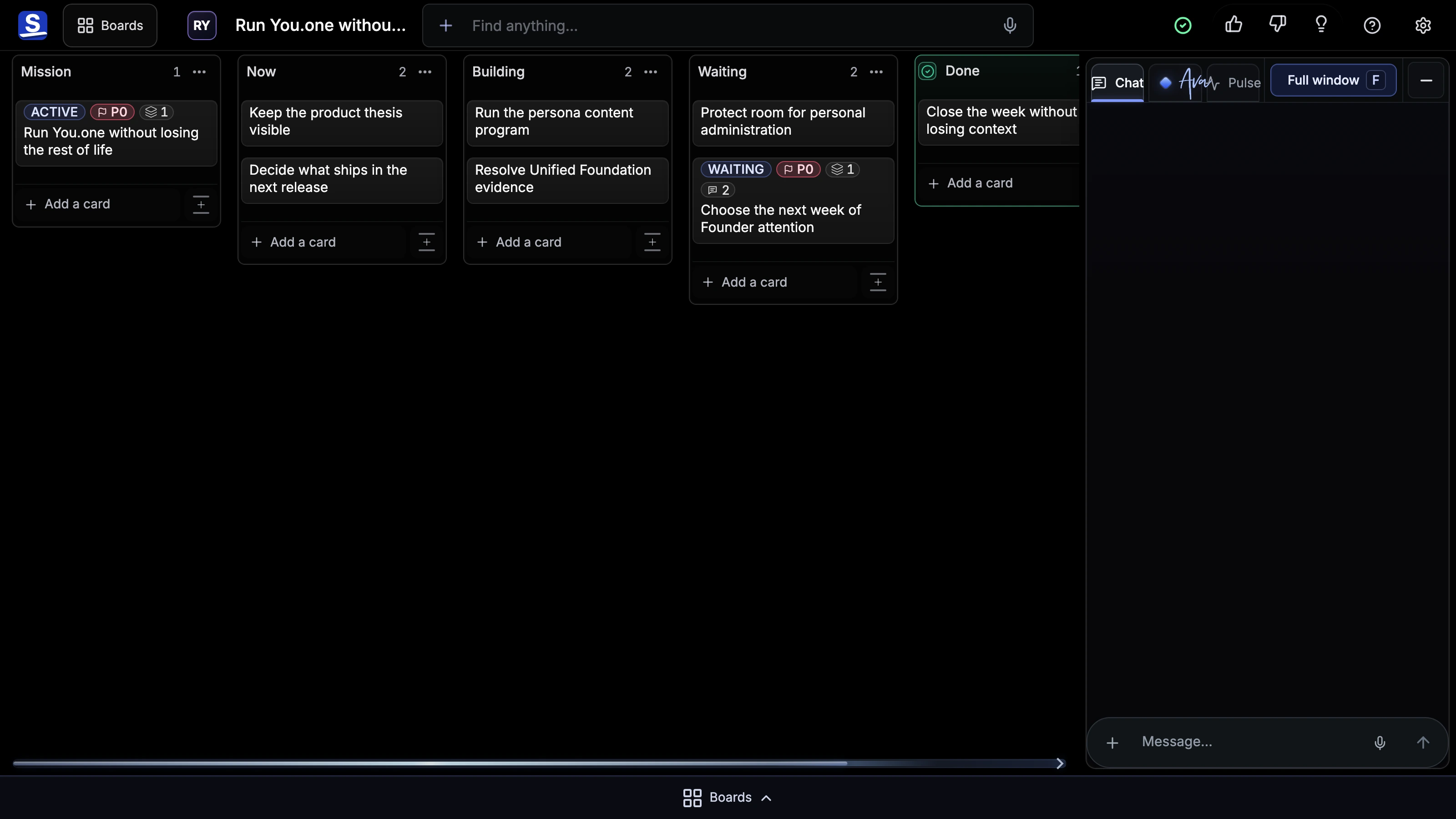
The reconstructed Board uses Mission, Now, Building, Waiting, and Done. Mission holds the purpose: keep the product thesis visible and refuse to let personal administration vanish behind product urgency. Now holds judgment that needs Founder attention this week. Building holds longer-running creation. Waiting holds work that is blocked on evidence, other people, or a later date. Done keeps closure from depending on memory.
The Cards are not all tasks. Keep the product thesis visible is a constraint. Decide what ships in the next release is a judgment. Run the persona content program and Resolve Unified Foundation evidence are bodies of work. Protect room for personal administration is a boundary. Choose the next week of Founder attention is the decision that makes the rest of the Board honest. Current Superboard can hold those different kinds of work, move them, date them, and reopen them without flattening them into one long to-do list.
That is the useful change from a wall of notes or a giant collection of Cards. The field stays glanceable and movable. The difference is that an important item can be opened later and still contain the work, not only the title that used to be stuck to the monitor.
Available today
The Card is visible; the reason survives inside the Room
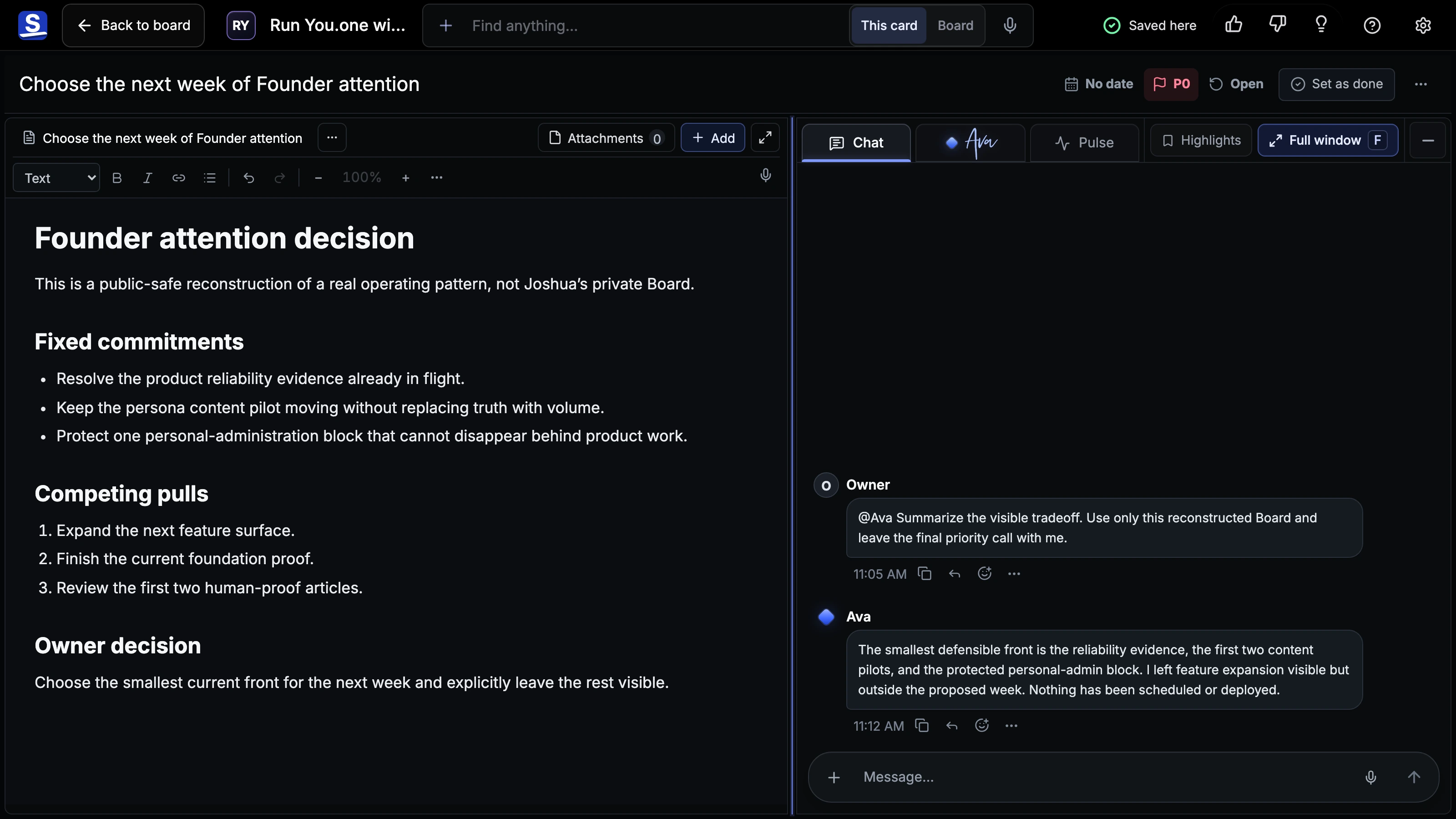
A Card on the Board can be scanned and moved like a sticky note. Opening it becomes a Room. The reconstructed decision Card, Choose the next week of Founder attention, keeps a working Document in Stage: fixed commitments, competing pulls, and an explicit Owner decision. Chat sits beside that brief. Pulse shows that the Card is waiting for the Owner. Activity records that Ava prepared a brief and left the call with Joshua. File references and Checklists can join the same Room when the work needs them. The visible front and the durable depth are one piece of work.
The brief in this reconstruction does not ask how to do everything. It asks what deserves the next week. The fixed commitments are the reliability evidence already in flight, the first two human-proof content articles, and one personal-administration block that cannot disappear behind product work. The competing pulls are expanding the next feature surface, finishing the current foundation proof, and reviewing those articles. The job of the Room is to keep that tradeoff in one place instead of scattering it across chats, notes, and a changing week.
The modest outcome is a chosen front, not a solved company. In this reconstruction, feature expansion remains visible on the Board and outside the proposed week. Nothing has been scheduled, deployed, or communicated externally by Superboard. Joshua remains the Owner of company mission, personal constraints, release authority, spending, and final direction. The Board’s job is to make that ownership visible enough to exercise.
Available today
Where Ava helps today
Inside this Room, Joshua can ask Ava to work from the Board and Card in front of her. In the reconstruction he asks her to summarize the visible tradeoff using only this Board and to leave the final priority call with him. Current Superboard can return that kind of supported insight from present context, keep the request and response in Chat, and make limited organizational changes through governed, undoable product paths.
Ava does not currently review every private system around the company, carry personalized memory from other Boards into this one, follow up on her own, or execute a release. She can help clarify, compare, structure, summarize, and prepare within the described Board and Card. She does not become the Founder. The reconstruction is explicit about that boundary because the private account would be easy to over-read as already-complete Co-owner magic.
The Founder recipe
This recipe is adaptable, not a required template. Another Founder might name Lists for a launch, a fundraising constraint, or a family calendar. The durable idea is smaller: one Board per mission that needs its own scan, Cards flexible enough to hold decisions as well as tasks, and a Room when the visible item has a reason that must survive the week.
| Layer | Job |
|---|---|
| Separate Board | Give each durable mission or responsibility its own operating picture |
| Mission Card | Keep the purpose and the constraints that must not vanish visible |
| Now and Building | Separate immediate judgment from longer-running creation |
| Decision Room | Keep evidence, options, conversation, and the Owner’s call together |
| Waiting and Done | Preserve commitments and closure instead of carrying both in memory |
Direction
Direction: one Ava across guidance and command center
The destination is for the same Ava to carry relevant personalized context between the wider You.one guidance relationship and the governed Board surface across days. That is how the system can become continuous orientation rather than a one-shot chat beside a separate project tool.
The unified You.one and Superboard runtime, shared personalized Memory Spine, broad proactive coordination, and general external execution have not shipped. This page does not use the Founder story to imply otherwise.
What this example does not prove
- It is not a claim that Joshua’s private production data is public or represented literally.
- It is not evidence that Ava autonomously runs You.one, coding environments, releases, finances, or personal life.
- It does not promise that every person should copy this exact structure.
- It shows a real working pattern and one current product slice, not a measured customer outcome.