Example
How a content creator can move from idea to finished work without losing the point
Elena does not lack ideas. She loses the reason an idea mattered while it moves through research, client work, drafts, assets, and release pressure. A Board shows the pipeline; each serious piece gets a Room where the intention and evidence survive revision.
This fictional example was created with AI assistance from a structured editorial brief and reviewed for reader usefulness and product truth before publication.
Elena is a fictional 34-year-old independent video essayist in Toronto, not a customer or testimonial.
Ideas remain cheap until they earn a brief; the Room then keeps the premise, sources, draft decisions, assets, and release checklist together.
Current Superboard does not publish, schedule, ingest analytics, or monitor performance. Ava can help with bounded preparation from the context Elena has placed in the work.
The pipeline is easy. Keeping the reason is the work.
A creator moves from idea to finished work without losing the point by letting a piece earn structure as it becomes a commitment, then keeping the premise, sources, and exclusions in the same Room as the draft. Elena is a fictional 34-year-old independent video essayist in Toronto. She publishes one substantial piece every two weeks and supports the practice with part-time client editing. The pressure is not a shortage of ideas. It is continuity. By the time a promising thought becomes a production deadline, she may remember the topic and have lost the original tension, the audience promise, or the evidence that made it worth pursuing.
Her notes application already contains hundreds of fragments. Research lives in browser tabs, drafts in documents, assets in folders, and release steps in a checklist copied from the previous piece. Each tool is good at its local job. None of them is responsible for the point of the work as it moves. A command center for a creator is not a denser idea inbox. It is a way for intention to survive revision.
Available today
Ideas earn structure as they become commitments
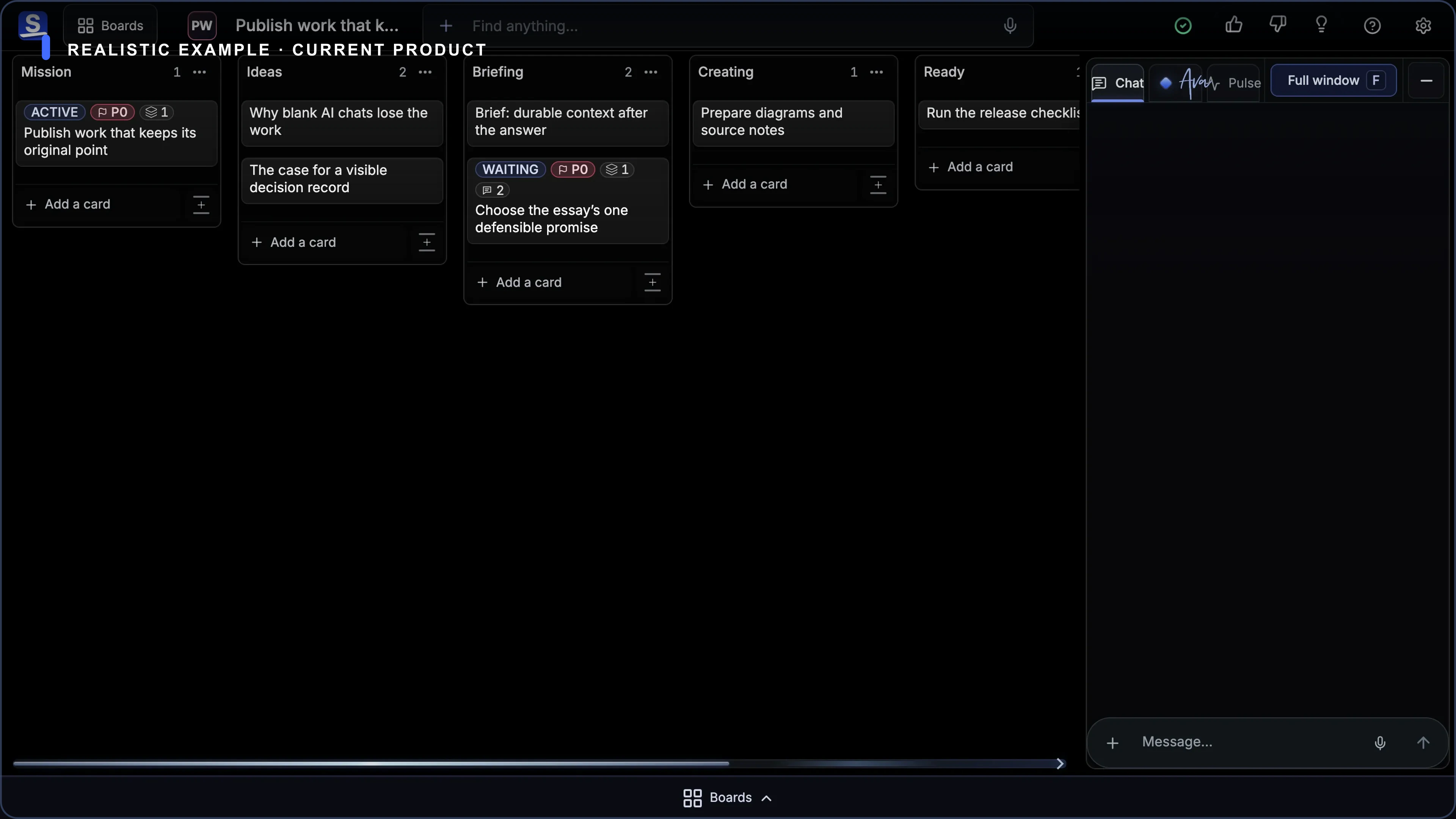
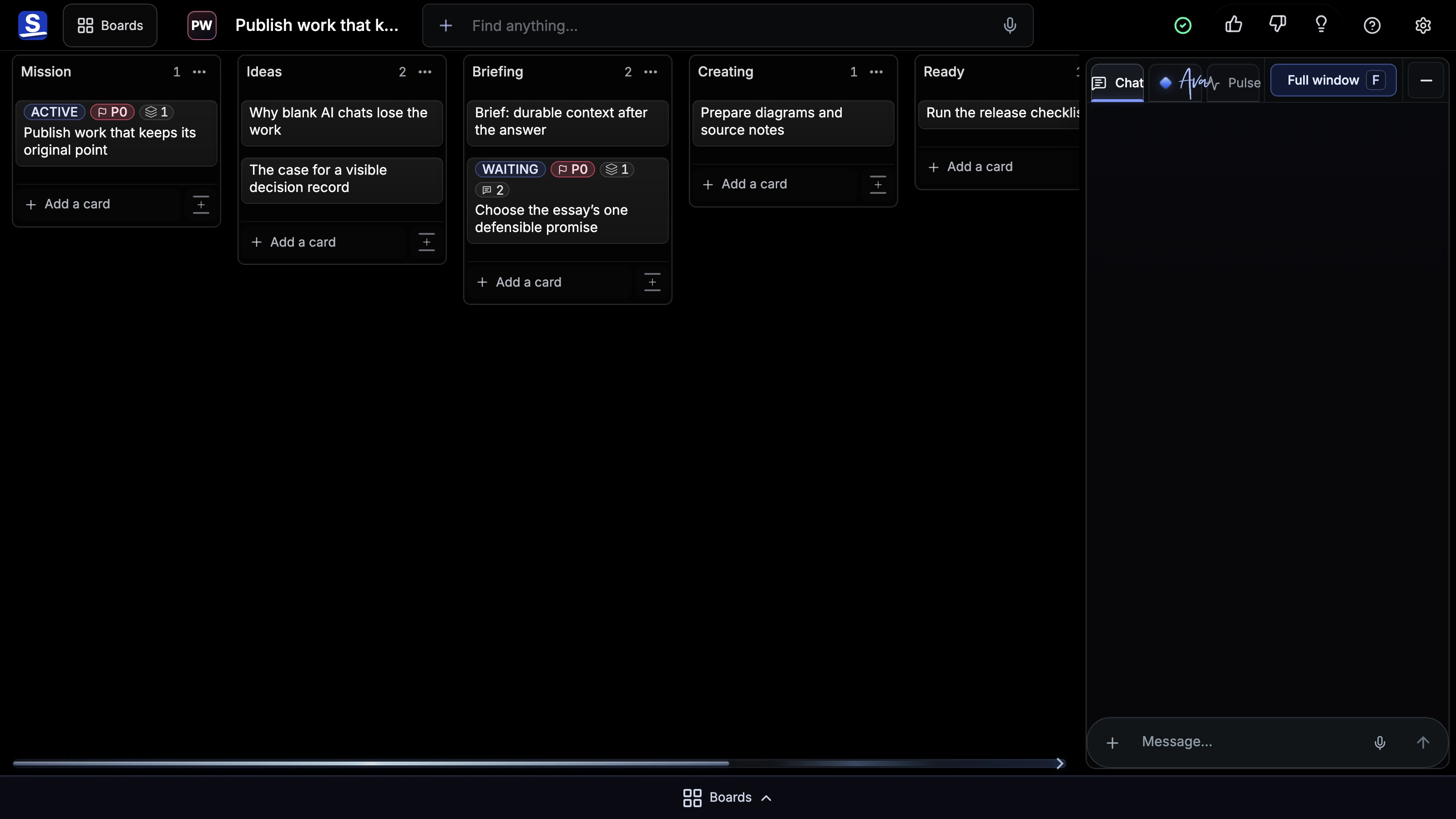
Elena’s fictional Board uses Mission, Ideas, Briefing, Creating, Ready, and Published. The mission is to publish one useful, defensible piece every two weeks without losing the audience promise. Why blank AI chats lose the work and The case for a visible decision record can stay lightweight in Ideas. Brief: durable context after the answer is a piece that has earned a premise. Choose the essay’s one defensible promise is the editorial judgment that prevents the draft from becoming a tour. Prepare diagrams and source notes is craft. Run the release checklist is readiness. Publish: the work should survive the chat is a record of a finished piece, not a button Superboard presses.
When an idea earns attention, its Room gains the premise Document, source references, research questions, draft Checklist, asset notes, Chat, Pulse, and Activity. A passing thought does not need that depth. A commissioned or scheduled piece no longer shares the same thin container as a shower observation. Current Superboard can hold that progressive structure today. It does not ingest Elena’s notes app, verify her sources, or watch her audience.
That is the change from a busy creative system to durable state. Ideas remain cheap and numerous. Commitments gain a home where the reason they exist can be reopened after a client job, a rewrite, or a week away from the cut.
The consequential choice is the promise, not the title
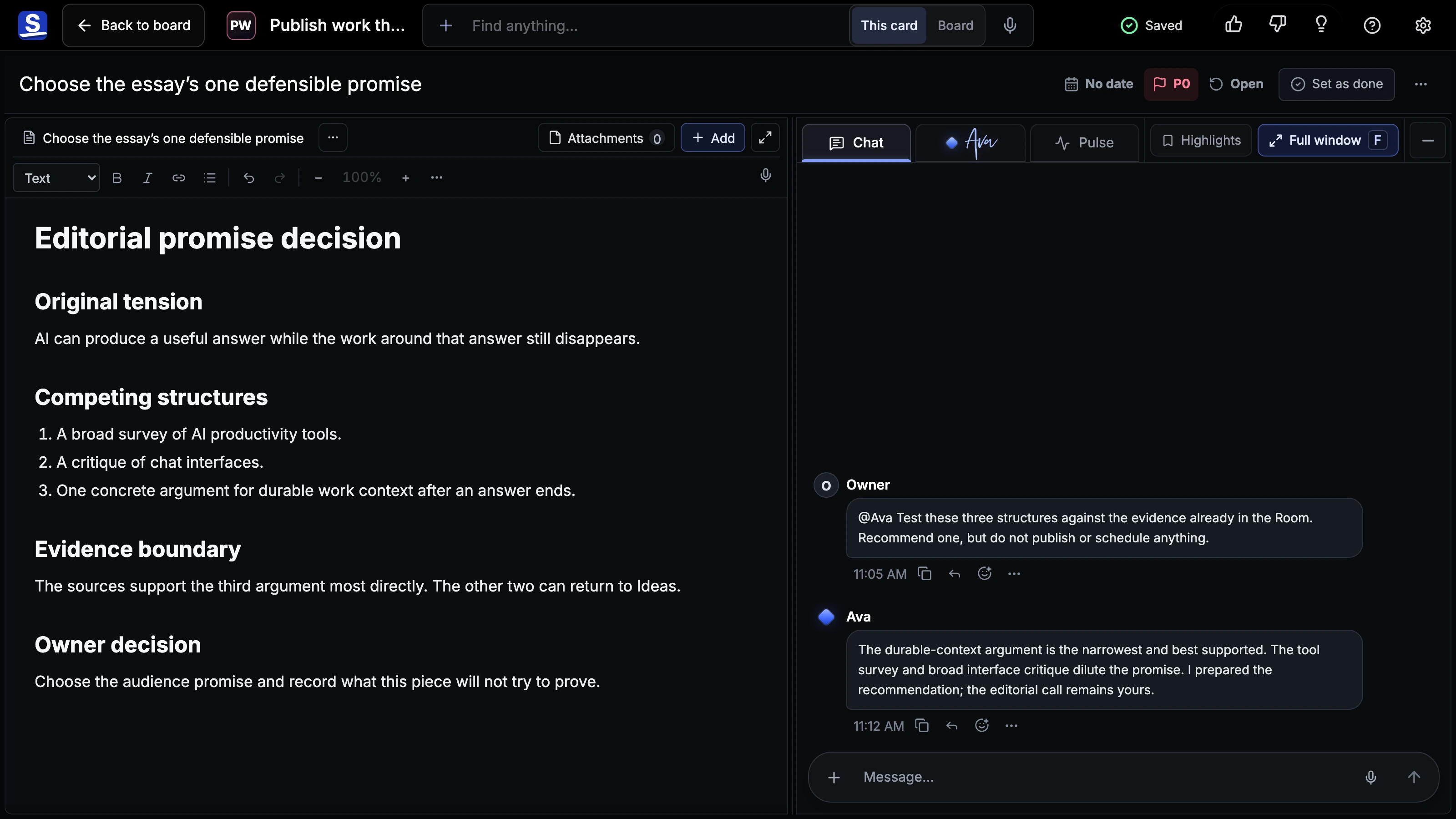
The Room for Choose the essay’s one defensible promise is where the piece either becomes itself or becomes generic. The original tension is still there: AI can produce a useful answer while the work around that answer disappears. Three competing structures have accumulated. A broad survey of AI productivity tools. A critique of chat interfaces. One concrete argument for durable work context after an answer ends. The sources in the Room support the third most directly. The release date will not wait for Elena to make all three pieces at once.
Elena can ask Ava to test those structures against the evidence already in the Room, recommend one, and neither publish nor schedule anything. The Stage Document keeps the tension, the options, and the evidence boundary. Chat keeps the editorial request. Pulse shows the Card waiting for the Owner. Activity records that a recommendation was prepared and that the call remained Elena’s. Narrowing is not a software feature. It is a taste decision with the evidence still attached.
The modest outcome is one piece with a reason to exist. Elena chooses the narrower promise: show why durable work context matters after an AI answer ends. She moves the tool survey and the broad interface critique back into Ideas. The Board now shows what this essay will not try to prove. That record is as useful as the draft. Future Elena, tired at the end of a client week, can see the exclusion and not smuggle the discarded arguments back in because they still sound clever.
Available today
Where Ava helps today
Elena can explicitly ask Ava to work from the current Card context, summarize the visible argument, identify contradictions, prepare an outline, or help organize supported Board items. The request and response remain beside the work, which makes later editorial judgment easier to reconstruct. Ava can be a serious reader of what Elena has already placed in the Room. She is not a ghostwriter with a publishing key.
Current Superboard does not browse Elena’s private research by default, verify every source automatically, publish to a platform, schedule promotion, ingest analytics, or monitor performance. Elena owns source quality, voice, rights, claims, publication, and the audience promise. A tool that posted the essay for her would still leave her responsible for what it said.
The creator recipe
Change the stages if the practice is different. A photographer may need a List for selects. A newsletter writer may not need assets in the same way. Keep Ideas cheap. Do not let a fragment borrow the gravity of a brief. Record exclusions in the Room once a promise is chosen; that is how the point survives the next draft.
| Stage | Minimum proof before moving |
|---|---|
| Ideas | A tension, question, or observation worth remembering |
| Briefing | Audience, promise, evidence need, and why this piece should exist |
| Creating | Working draft, source context, decisions, and asset Checklist |
| Ready | Claims reviewed, assets complete, final Owner decision recorded |
| Published | Canonical link, release record, and any deliberate follow-up |
| Decision Room | Competing structures, exclusions, and the editorial promise |
Direction
Direction: one relationship across the creative cycle
Direction is for the same Ava to preserve relevant personalized context across days, help move from rough thought to structured work, and execute supported release steps only through governed connections and authority. The command center and the guidance experience become one continuous creative relationship.
That unified runtime, broad source access, publishing execution, and analytics loop are not current. Best practice today is to keep the source material and decision context with the Card, then perform external publication in the appropriate tool. Elena is a fictional example. This page does not report a channel result, a watch-time change, or a creator Superboard has worked with.