Example
How to build a job-search command center without automating your judgment
Darnell’s job search is not one task called ‘find a job.’ It is a changing portfolio of companies, promises, evidence, conversations, waiting, and judgment. A Board shows the pipeline; each role’s Room preserves why it may or may not be worth pursuing.
This fictional example was created with AI assistance from a structured editorial brief and reviewed for reader usefulness and product truth before publication.
Darnell is a fictional 43-year-old operations leader in Minneapolis, not a customer or testimonial.
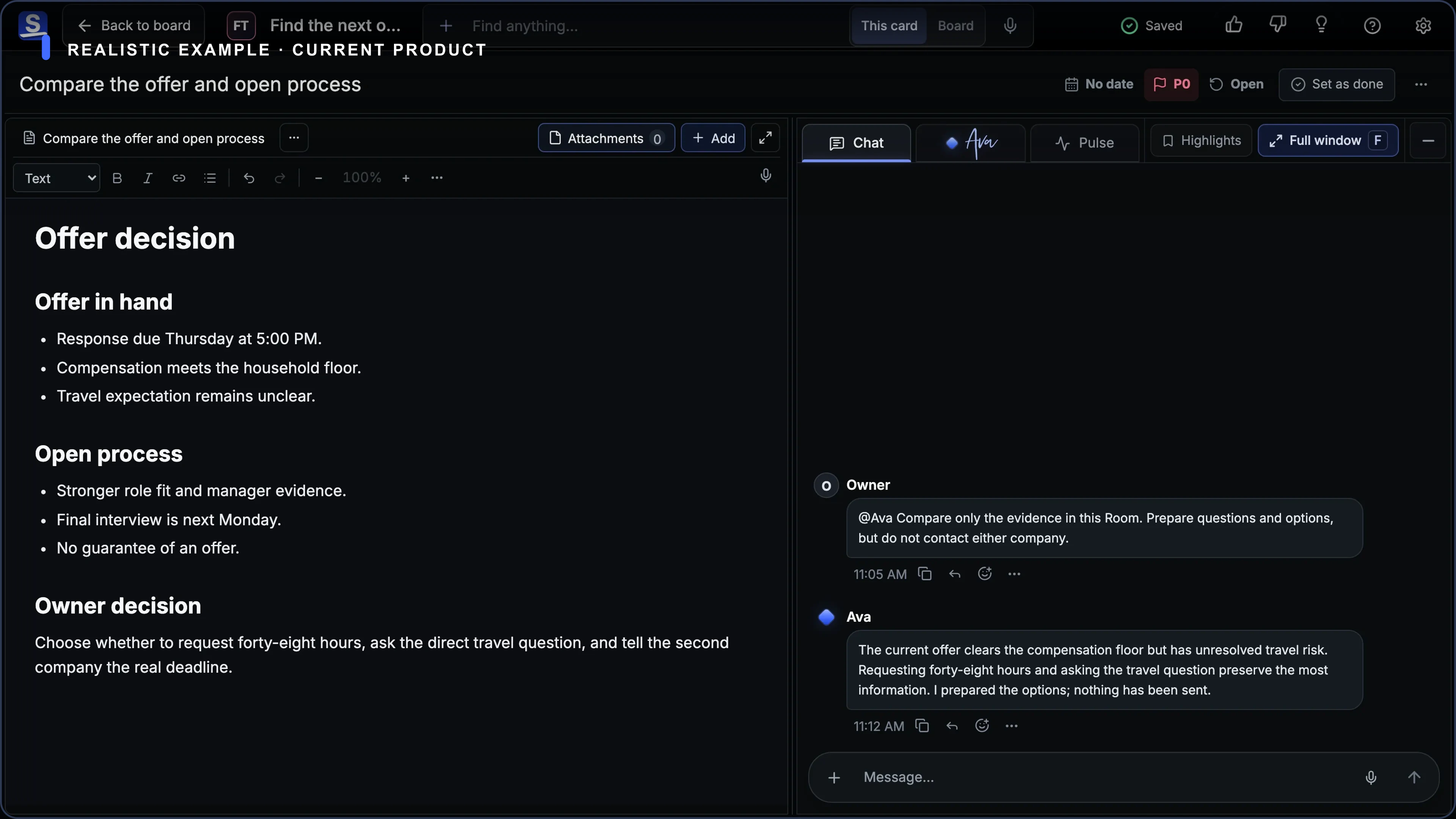
Target roles, preparation, applications, interviews, waiting, and closed opportunities stay visible without reducing people or companies to a spreadsheet row.
Superboard does not scrape openings, auto-apply, send outreach, or choose an offer. Ava’s current role is bounded preparation from context already present.
The search is a portfolio of judgments, not a task named find a job
A job-search command center is a visible pipeline of roles, evidence, people, and waiting—not a machine that applies, follows up, or chooses. Darnell is a fictional 43-year-old operations leader in Minneapolis looking for work after a layoff. He has two children, a mortgage, eighteen years of experience, and no interest in spraying generic applications across the internet. The pressure is time with a household attached: he needs a role with credible leadership scope, reasonable travel, and compensation that protects the family, and he cannot let the nearest deadline make that choice by default.
A spreadsheet can record a status. It rarely preserves why a company moved from interesting to doubtful, what a hiring manager actually said, which résumé version was sent, or what Darnell promised to send next. Those details migrate into email, documents, calendar entries, and memory precisely when the stakes rise. The command center’s job is to keep the pipeline honest without automating the representation of a person.
Available today
A pipeline that preserves reasons
The fictional Board uses Mission, Target roles, Preparing, Applied, Interviewing, Waiting, and Closed. The mission is to choose a credible operations leadership role that protects family, financial, and travel constraints. A Card represents one role or one cross-search decision. Northstar VP Operations and Lake Street Head of Fulfillment can sit in Target roles until they earn real preparation. Tailor the operations résumé is work that serves more than one company. Applied: Harbor Logistics records what was sent and when. Interviewing: Meridian Health is where conversation evidence belongs. Closed: Eastline Regional Director is not a failure bin; it records why Darnell or the company ended the process so the search becomes more informed instead of merely longer.
Opening a role Card reveals the Room where Darnell can keep the tailored résumé, research notes, interview questions, people involved, follow-up Checklist, Chat, Pulse, and Activity together. The Board answers where each opportunity stands. The Room answers why. Current Superboard can hold that structure today. It does not collect openings, log in to employer sites, or move a Card because an application was submitted somewhere else.
That is the change from a noisy search to durable state. The pipeline stays scannable. The reasons stay attached to the role they belong to, including the roles Darnell has already declined or lost.
The hard Card is not the application—it is the offer decision
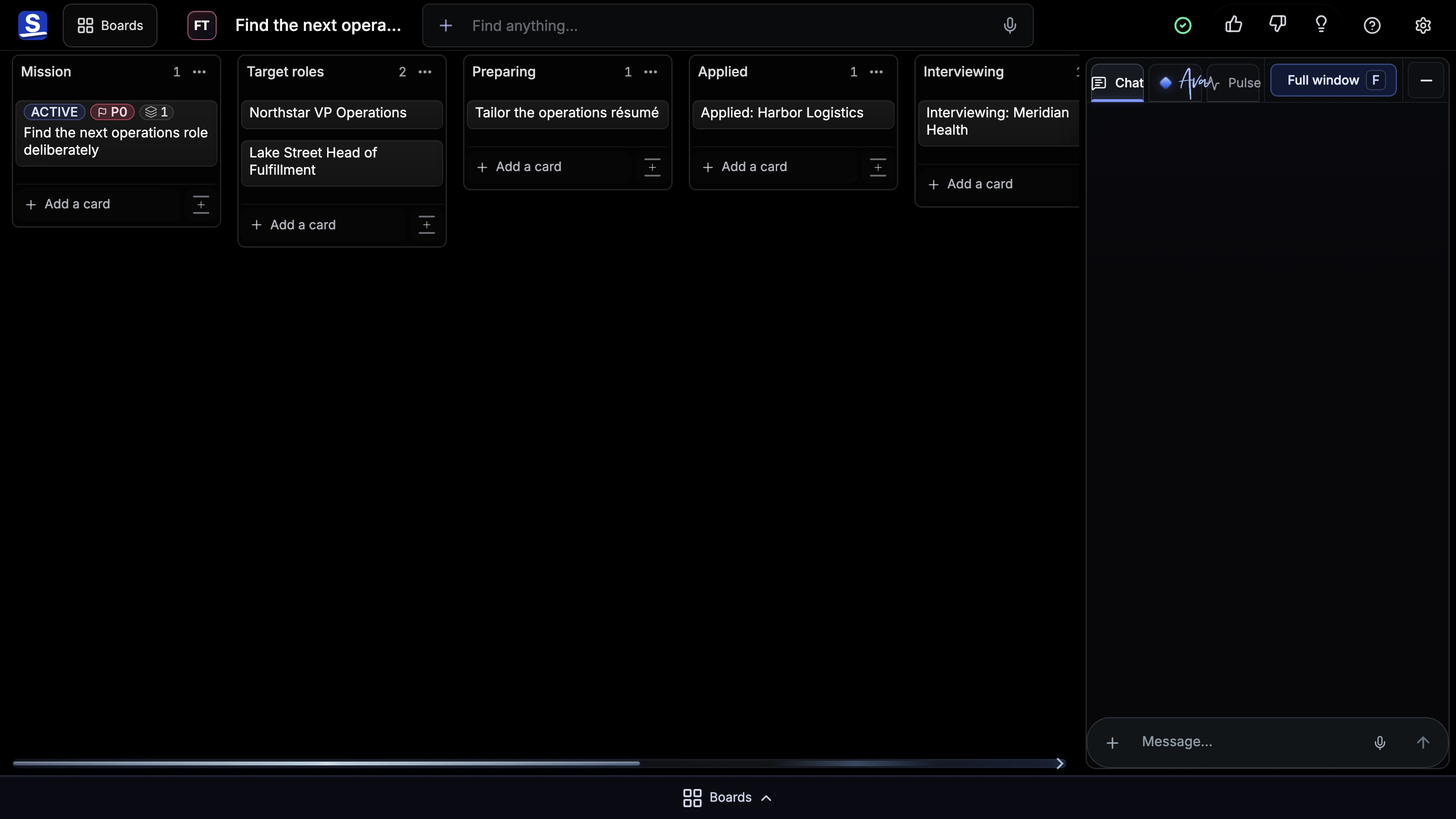
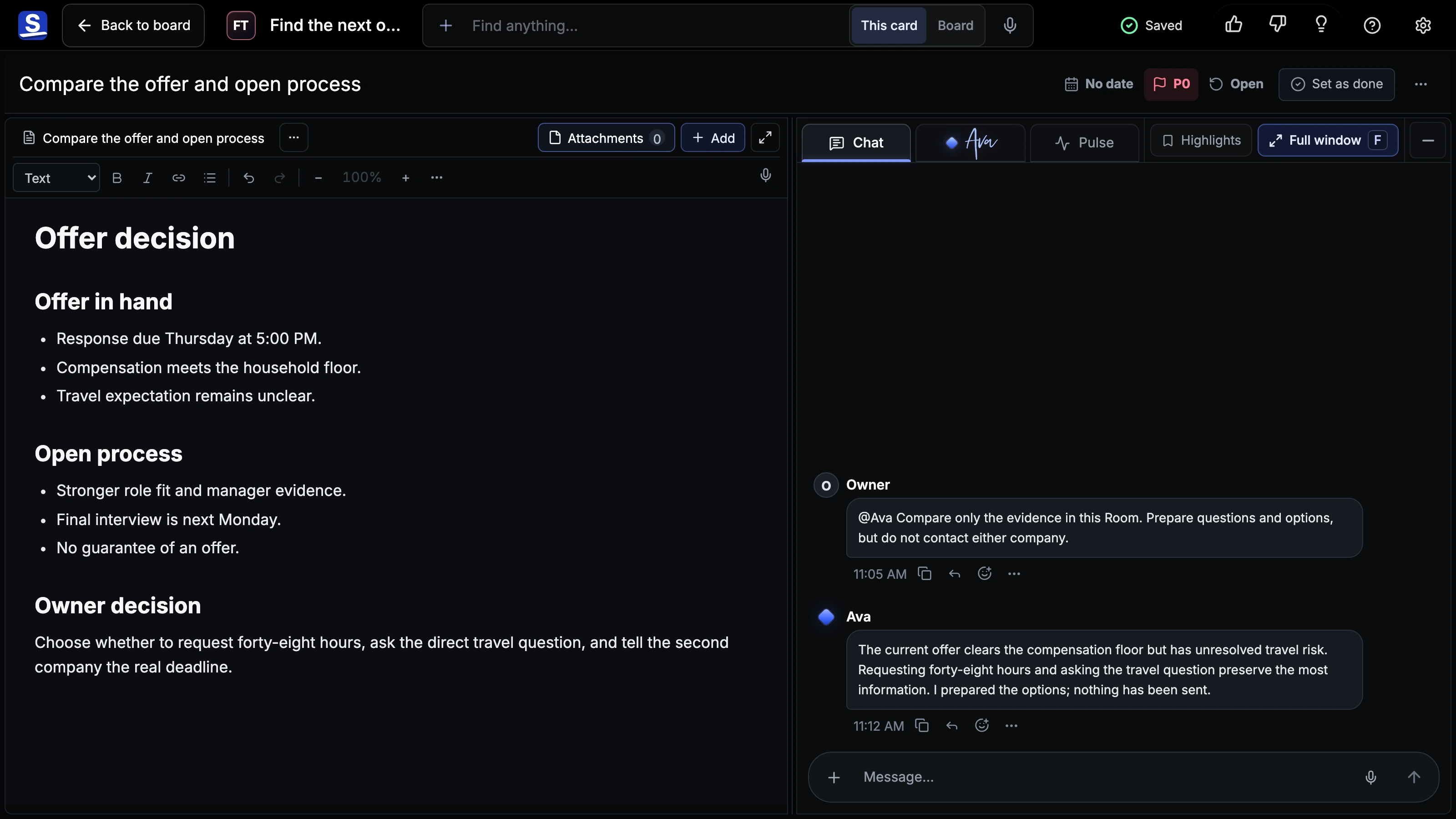
The consequential Room, Compare the offer and open process, is the command center at its most serious. One offer is in hand, with a response due Thursday at 5:00 p.m. Compensation meets the household floor. Travel expectation is still unclear. Another process, with stronger role fit and manager evidence, has a final interview on Monday and no guarantee. The Board makes the time pressure visible. The Room keeps the compensation, travel risk, family constraint, manager evidence, and uncertainty in one decision instead of letting Thursday’s clock choose.
Darnell can ask Ava to compare only the evidence in this Room, prepare questions and options, and contact neither company. The Stage Document holds the two paths. Chat keeps that bounded request. Pulse shows the Card waiting for the Owner. Activity records that options were prepared and that nothing was sent. The product can help him see the comparison. It cannot represent him.
The modest outcome is a deliberate next move, not a guaranteed better job. In this example Darnell requests forty-eight hours, asks one direct travel question, and tells the second company the real deadline. The structure does not remove uncertainty. It helps him make a choice he can explain to himself and to his family, rather than accepting the first complete packet because it arrived first.
Available today
Ava can prepare; Darnell represents himself
Darnell can ask Ava to summarize the role context already stored in a Room, compare visible criteria, prepare questions, or reorganize supported Board items. The response remains beside the source context and does not masquerade as an application, a follow-up email, or an acceptance sent on his behalf.
Current Superboard does not scrape job sites, monitor openings, tailor and submit applications autonomously, read email, contact recruiters, schedule interviews, negotiate, or accept an offer. Those would not be helpful extras in this story. They would change who is speaking. Darnell owns accuracy, representation, relationships, and the final decision. A search tool that applies for him would still leave him to live the job.
The job-search recipe
Adapt the Lists to the search you actually have. A first role out of school may not need a Closed column yet. A confidential search may need a Card named for the work, not the company, on a private Board. The durable idea is the same: one visible state per serious opportunity, and one Room once there is evidence worth keeping.
| List or Room | Question it answers |
|---|---|
| Target roles | Is this opportunity worth real preparation? |
| Preparing | What evidence and tailoring must happen before applying? |
| Applied | What was promised and when? |
| Interviewing | What did each conversation reveal or contradict? |
| Waiting | Who owns the next move and when should Darnell reconsider? |
| Closed | Why did this end, and what should change in the search? |
| Decision Room | Which choice best fits the work, family, money, and evidence? |
Direction
Direction: governed help around the search
Direction could let Ava carry more relevant context across the search, prepare stronger materials, notice inconsistencies, and execute supported actions only through applicable connections and explicit authority. It does not turn job seeking into an invisible application bot.
The best-practice principle survives either way: automate preparation carefully; keep identity, truth, consequential judgment, and relationship authority with the person. Darnell is a fictional example. This page is not a placement record, a testimonial, or proof that Superboard finds jobs.